



The honest answer isn’t a single number — it depends on where you’re starting from, how your body is recovering, and what you’re actually trying to achieve. But the research narrows it down considerably, and what it says might surprise you.
In This Article
- The short answer
- What the research actually says about training frequency
- Why recovery matters more after 40
- Frequency by goal: beginner, intermediate, fat loss, bone density
- Signs you’re training too often
- Signs you’re not training enough
- Sample weekly schedules that actually work
- What to do on rest days
- FAQ
The Short Answer
2–3 times per week for most women over 40. That’s the range supported by both the research and by what works in practice for women at this stage of life.
If you’re a beginner, start with 2 sessions per week. Your nervous system and connective tissue need time to adapt to a stimulus they haven’t experienced before. Two sessions gives you adequate stimulus for adaptation while leaving room for your body to actually do the adapting.
If you’ve been training for 6–12 weeks and the 2-session schedule feels manageable, add a third. Three well-structured full-body sessions per week is the sweet spot for most women over 40 — enough frequency to build muscle and strength consistently, enough rest to recover between sessions.
Beyond 3? It’s possible, but only with proper programming — specifically splitting your training so the same muscle groups aren’t working hard twice in less than 48 hours. More sessions don’t automatically mean better results. In many cases after 40, they mean slower progress because recovery is being shortchanged.
The Number That Matters More Than Frequency
Weekly training volume — the total number of challenging sets per muscle group per week — matters more than how many days you train. 12 sets for your legs spread across 3 days produces the same stimulus as 12 sets spread across 2 days. The frequency question is really about how you distribute the volume to maximize recovery.
What the Research Actually Says About Training Frequency
The American College of Sports Medicine (ACSM) recommends resistance training 2–3 days per week for most adults, with each major muscle group trained at least twice per week for optimal strength and hypertrophy outcomes. This recommendation specifically applies to postmenopausal and older women.
A 2019 meta-analysis in the Journal of Strength and Conditioning Research found that training each muscle group twice per week produced significantly greater muscle hypertrophy than once per week — even when total weekly volume was equated. Frequency of the stimulus matters for the adaptation signal, not just the total load applied.
What’s equally important: the same analysis found no significant additional benefit from training each muscle group three times per week compared to twice, when volume was matched. This tells you something useful. The ceiling on frequency returns is relatively low — and for women over 40 managing recovery alongside hormonal changes, sleep disruption, and the general demands of midlife, there’s real cost to chasing higher frequency without a corresponding benefit.
A long-term study on resistance training in postmenopausal women — the BEST (Bone Estrogen Strength Training) trial — used a format of three sessions per week for its primary resistance training group. After six years, women who maintained that 3x weekly frequency showed significantly better body composition, bone density, and weight management outcomes than controls. Six years of 3x per week. Not six days per week. Not once a day.
2× Minimum frequency per muscle group per week for meaningful strength and muscle gains
48–72 Hours needed between sessions targeting the same muscle group after 40
6 yrs Duration of BEST study showing superior outcomes at 3x per week frequency
3× Weekly sessions — the sweet spot supported by both research and real-world adherence
Why Recovery Matters More After 40 Than It Did Before
Here’s the physiological reality that changes the equation for women over 40: you don’t get stronger during a training session. You get stronger in the 24–72 hours after it — during the recovery window when your body repairs the micro-damage caused by lifting and rebuilds the tissue slightly stronger than before.
That recovery process is driven by growth hormone (released primarily during deep sleep), protein synthesis in muscle tissue, and the suppression of the inflammatory response triggered by training. After 40, each of these is affected:
Growth hormone declines. Peak GH secretion drops significantly after 30 and continues declining through your 40s and 50s. Less GH means the recovery and rebuilding phase takes longer — sometimes meaningfully so. What took 36 hours to recover from at 28 may genuinely need 48–60 hours at 45.
Estrogen decline affects muscle repair. Estrogen has anti-inflammatory properties and plays a direct role in muscle protein synthesis. As it declines during perimenopause and menopause, both the speed and efficiency of muscle recovery are reduced. This isn’t dramatic — you don’t become unable to recover — but it shifts the optimal rest window.
Sleep is often disrupted. Night sweats, hormonal fluctuations, and elevated cortisol from chronic life stress disrupt the deep sleep stages where recovery hormones are most active. Poor sleep quality directly impairs muscle repair. A 40-minute training session followed by a poor night’s sleep produces a fraction of the adaptation of the same session followed by 8 hours of quality sleep.
None of this means training less. It means the rest days between sessions are part of the training, not a gap in it. Treating rest days as failures is a thought pattern that actively undermines results after 40.
The Training Myth That Hurts Women Over 40 Most
“More is always better.” It’s not. The women I’ve seen struggle most with plateau and burnout in their 40s are almost always training too frequently with inadequate recovery — not too little. The adaptation you’re chasing happens in the rest, not the session. Protecting your recovery is not laziness. It’s the strategy.
Frequency by Goal: The Right Answer Depends on What You’re Training For
If you’re a complete beginner
2 sessions per week. Your nervous system is learning new movement patterns while your muscles, tendons, and ligaments are adapting to a load they haven’t experienced before. Muscle tissue adapts faster than connective tissue — tendons and ligaments need more time, and pushing frequency too high before they’re ready is how beginners get hurt. Two sessions per week for your first 6–8 weeks builds the foundation without overwhelming the system.
Use those two sessions as full-body training — all major movement patterns (squat, hinge, push, pull, carry) in every session. Our 4-week beginner strength plan uses exactly this structure — 2 sessions per week in weeks 1 and 2, building to 3 from week 3 onward.
If you’ve been training for 2–3 months
3 sessions per week. By now your connective tissue has had time to adapt, your technique is more consistent, and your nervous system is no longer using all its resources just learning the movements. Three sessions per week — ideally on non-consecutive days — is where the most consistent long-term progress happens for most women over 40.
Keep the full-body structure or transition to an upper/lower split where each half of the body trains twice per week.
If your primary goal is fat loss and body recomposition
3 sessions per week of strength training, plus daily movement. The metabolic benefits of strength training — elevated resting metabolic rate from lean muscle gain, improved insulin sensitivity, better blood glucose regulation — are maximised at 3 sessions per week. Adding low-intensity movement on rest days (walking, cycling at easy effort, gentle yoga) increases total calorie expenditure without adding recovery stress. This combination outperforms cardio-only approaches for perimenopausal body composition in the research.
Nutrition matters more than training frequency for fat loss specifically — read our complete guide on protein targets for women over 40 if this is your primary goal.
If your primary goal is bone density
2–3 sessions per week of weight-bearing resistance training. The bone remodeling stimulus from strength training requires adequate recovery time between sessions — bone responds to repeated mechanical loading signals, but needs the intervening rest period to complete the remodeling cycle. Research from the LIFTMOR trial used twice-weekly sessions for its bone density intervention in postmenopausal women and produced significant improvements at the spine and hip. Three sessions per week may provide modest additional benefit, but twice weekly is sufficient and well-supported.
If you’ve been training consistently for 12+ months
3–4 sessions per week with a structured split. At this point, a full-body approach 4 times per week creates too much overlap — the same muscles are being challenged before they’ve fully recovered. A structured split — upper/lower or push/pull/legs — allows you to train 4 days per week while giving each muscle group 72+ hours of recovery before it’s challenged again.
This is the level of programming where working with a trainer or following a structured program pays real dividends. Frequency is only as useful as the programming that supports it.
Signs You’re Training Too Often
The body gives clear signals when training frequency is exceeding recovery capacity. Pay attention to these:
- Performance declining week to week. If your weights or reps are going down consistently — not on an off day, but across multiple sessions — your body is not recovering between sessions. More training is making you weaker, not stronger.
- Persistent soreness that never fully clears. Some soreness in the first week or two of a new program is expected. Constant, unrelenting muscle soreness that doesn’t improve with rest days is a sign of insufficient recovery time between sessions.
- Elevated resting heart rate. If you track morning resting heart rate and see it consistently 8–10 beats higher than your baseline, your autonomic nervous system is under chronic stress. This is one of the clearest physiological markers of overtraining.
- Sleep getting worse despite being tired. Paradoxically, overtraining disrupts sleep quality. Elevated cortisol from excessive training stress impairs the deep sleep stages where recovery happens — creating a cycle where more training produces worse recovery.
- Loss of motivation and dreading sessions. Genuine overtraining includes a psychological component — a flat, unmotivated feeling toward training that doesn’t respond to a single rest day. This is your nervous system telling you it needs more time.
- Joint pain rather than muscle fatigue. Muscle fatigue is expected and recovers quickly. Persistent joint pain — particularly in the knees, hips, shoulders, or lower back — after every session suggests your connective tissue is not getting adequate recovery time.
Signs You’re Not Training Enough
Under-training is just as real as overtraining, and far more common among women who are new to lifting or who have been trained by culture to believe they should be “gentle” with themselves.
- Never feeling challenged. If every session ends feeling like it was easy — no effort, no real exertion — the stimulus isn’t high enough to drive adaptation. Training should be hard. Not painful, but genuinely demanding.
- No progression week to week. You should be adding weight, reps, or difficulty on a regular basis. If you’re doing the same weights for the same reps for 8 weeks in a row, nothing is changing because nothing is being challenged.
- No changes in body composition after 8+ weeks. Meaningful changes in body composition require adequate training stimulus. Once a week at low intensity won’t produce the metabolic or structural changes that twice or three times per week at moderate-to-high intensity does.
- Energy levels not improving. One of the clearest early signs of adequate training is improved energy. If you’ve been “exercising” for weeks without any change in daily energy levels, the training stimulus probably isn’t high enough — in either intensity or frequency.
Sample Weekly Schedules That Actually Work
Schedule A: 2 days per week (beginner)
Monday
Full-Body Session A Goblet squat · Single-arm row · Floor press · Dead bug · Farmer’s carry
Tuesday
Active rest — walk 20–30 min
Wednesday
Rest or light stretching
Thursday
Full-Body Session B Romanian deadlift · Shoulder press · Reverse lunge · Band pull-apart · Glute bridge
Friday–Sunday
Rest / walks / gentle yoga — no structured lifting
Schedule B: 3 days per week (most women over 40 — recommended)
Monday
Full-Body Session A Squat-focused · Pull-focused · Press · Core
Tuesday
Active rest — walk, swim, or cycle at easy effort
Wednesday
Full-Body Session B Hinge-focused · Push-focused · Row · Carry
Thursday
Rest or gentle yoga / mobility work
Friday
Full-Body Session A (repeated)
Saturday–Sunday
Rest — walks, family activities, whatever you enjoy
Schedule C: 4 days per week (intermediate, 12+ months training)
Monday
Upper Body Press · Pull · Shoulders · Arms
Tuesday
Lower Body Squat · Hinge · Lunges · Glutes · Calves
Wednesday
Rest or light cardio — 20–30 min walk
Thursday
Upper Body Different exercise variation from Monday — same patterns, new stimulus
Friday
Lower Body Different variation — emphasize posterior chain or add conditioning
Saturday–Sunday
Rest — active recovery, walking, stretching
Notice something consistent across all three schedules: there is never a day where the same muscle groups are worked two days in a row. That 48–72 hour gap is not negotiable. It’s where the results live.
What to Do on Rest Days
Rest days are not zero-activity days — they’re recovery days. There’s a meaningful difference.
Complete inactivity on rest days is actually less effective for recovery than gentle movement. Light aerobic activity — a 20–30 minute walk, easy cycling, gentle swimming — increases blood flow to recovering muscles without adding significant training stress. Better blood flow means faster clearance of metabolic waste products from the previous session and better delivery of nutrients to repairing tissue. Your muscles recover faster with gentle movement than with sitting still.
What to do on rest days that actively supports your strength training:
- Walk. 20–30 minutes at a comfortable pace. The most underrated recovery tool in existence. Also contributes meaningfully to bone density as a weight-bearing activity.
- Gentle yoga or mobility work. Hip flexor stretches, thoracic spine mobility, hamstring work. Targets the areas that get chronically tight from strength training and sitting.
- Foam rolling or the Chirp Wheel. 10–15 minutes of myofascial release, particularly on the back, quads, and hip flexors. See our home gym equipment guide for tested recovery tools.
- Sleep. If you can protect 7–9 hours on rest day nights, you’re doing more for your training outcomes than any supplement or extra session could achieve.
- Eat enough protein. Muscle repair doesn’t stop when training does — the rebuilding continues through your rest days. Hitting your daily protein target (1.6–2.0g per kg bodyweight) on rest days matters as much as on training days.
The Simplest Rest Day Rule
If it elevates your heart rate above a comfortable conversational pace and targets the same muscles you trained yesterday — it’s not a rest day activity. If it keeps you gently moving, stretching, or sleeping — it’s exactly what rest days are for.
Frequently Asked Questions
Is 2 days a week enough strength training for women over 40?
Yes — especially for beginners. Two well-structured full-body sessions per week produce meaningful improvements in strength, muscle mass, bone density, and metabolic health. Research shows that even once-per-week training is significantly better than none, and twice per week produces substantially better outcomes than once. If your schedule or recovery limits you to 2 sessions, make those 2 sessions count — quality and progressive overload matter more than frequency at the beginner level.
Can I strength train every day as a woman over 40?
Daily strength training targeting the same muscle groups is not recommended and is counterproductive after 40. Muscle tissue needs 48–72 hours to repair and rebuild after a challenging session — training the same muscles before that window closes interrupts the recovery process and produces diminishing returns at best, overuse injury at worst. Daily training is possible only with very careful programming that ensures different muscle groups work on consecutive days — and even then, 5–6 days per week provides no meaningful advantage over 3–4 days with adequate recovery built in.
Should women over 40 strength train more or less than younger women?
Similar frequency, more attention to recovery. The training frequency recommendations are broadly the same — 2–3 sessions per week for beginners, up to 4 for experienced trainees. What changes after 40 is how carefully you need to protect the recovery between those sessions. Longer rest between sessions targeting the same muscle groups (48–72 hours minimum), more attention to sleep quality, higher protein intake, and more deliberate warm-up and cool-down work all become more important — not less training, but smarter management of the training you do.
What happens if I miss a strength training session?
Nothing significant — one missed session in a consistent program is irrelevant to long-term results. Don’t try to compensate by cramming two sessions into one day or adding an extra session that week. Just resume your normal schedule. The only time missed sessions become a problem is when they become a pattern — missing 2 or more weeks consistently is where detraining begins. One session here and there is part of every real training life and should be treated as such.
How long should a strength training session be for women over 40?
30–50 minutes including warm-up and cool-down. After an hour of strength training, cortisol begins rising significantly and the hormonal environment becomes less favorable for muscle building. For women over 40 who are already managing elevated cortisol from life stress, sleep disruption, and hormonal changes — long sessions are counterproductive. A focused 40-minute session with proper warm-up, 4–5 exercises, and adequate rest between sets covers everything needed. The goal is quality and progressive challenge, not duration.
Should I do cardio on top of strength training after 40?
Yes, but not instead of strength training — alongside it. The ACSM recommends 150 minutes of moderate-intensity aerobic activity per week in addition to 2–3 strength training sessions. The most practical approach for women over 40: count your brisk daily walks toward your cardio target, keep dedicated cardio sessions on separate days from heavy strength training, and never do intense cardio before a strength session (it depletes the energy and neuromuscular resources you need for lifting). Strength training addresses more of the specific physiological changes of perimenopause than cardio alone — both matter, but strength comes first.
A Full Beginner Plan Built Around 2–3 Sessions Per Week
Every session, exercise, set, and rep planned out across 4 weeks — with the warm-up, cool-down, and week-by-week progression already built in. No guesswork. No wasted sessions.Get the 4-Week Plan →
Medical disclaimer: This article is for informational and educational purposes only and does not constitute medical advice. Training frequency recommendations may need to be modified based on individual health status, existing injuries, medical conditions, or medications. Consult your healthcare provider before beginning a new exercise program.
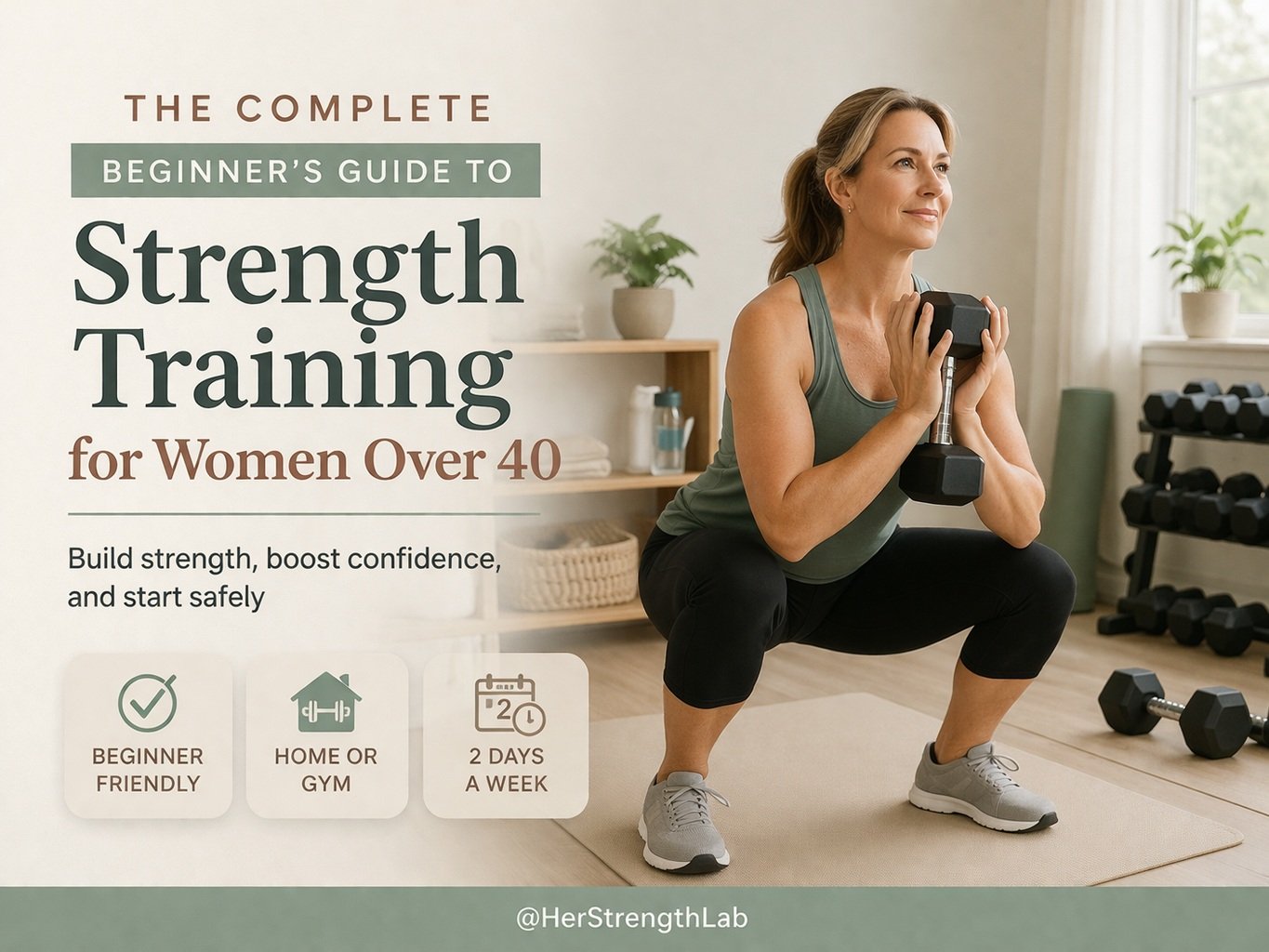

[…] How Many Times a Week Should a Woman Over 40 Strength Train? […]