


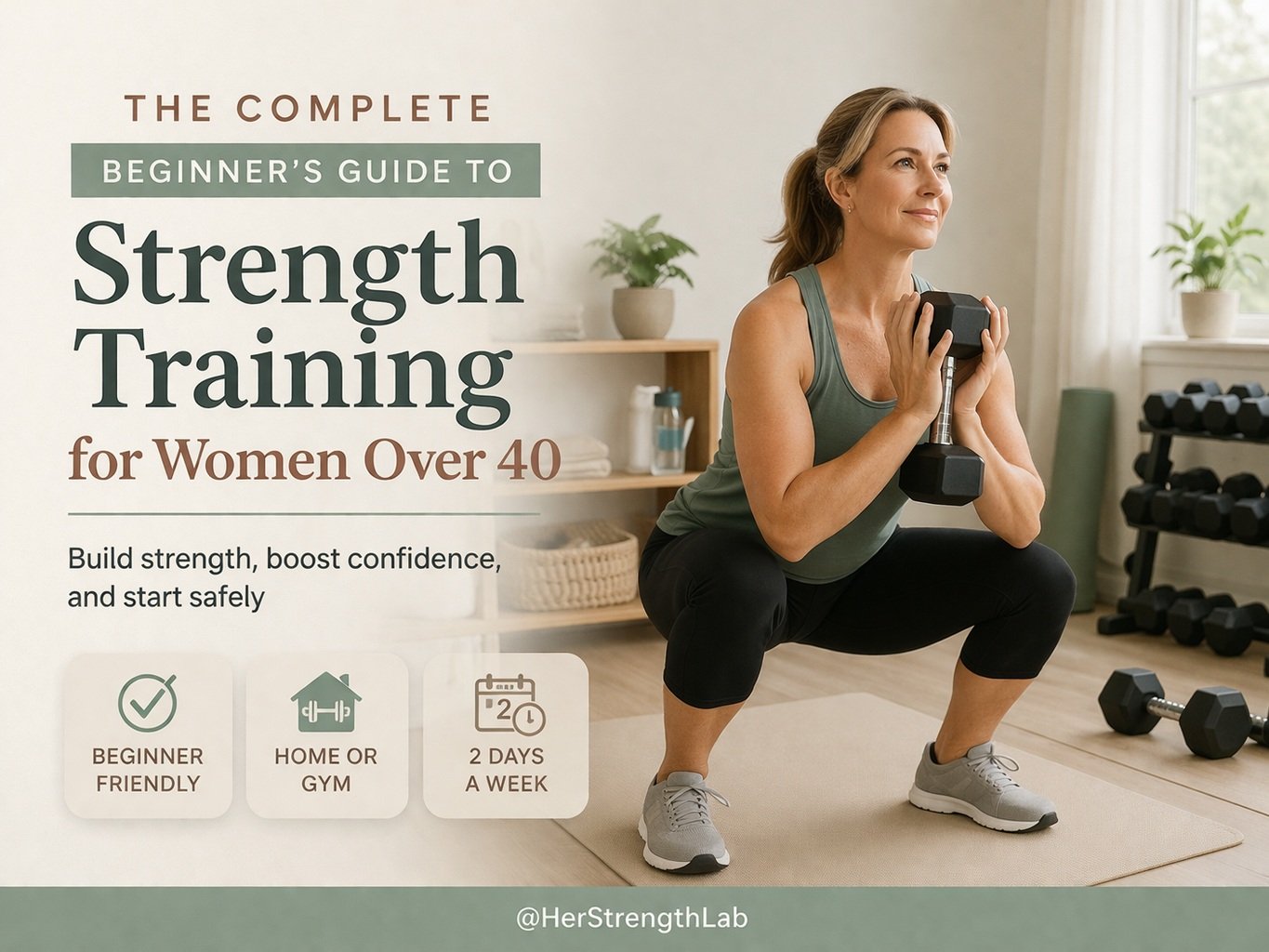
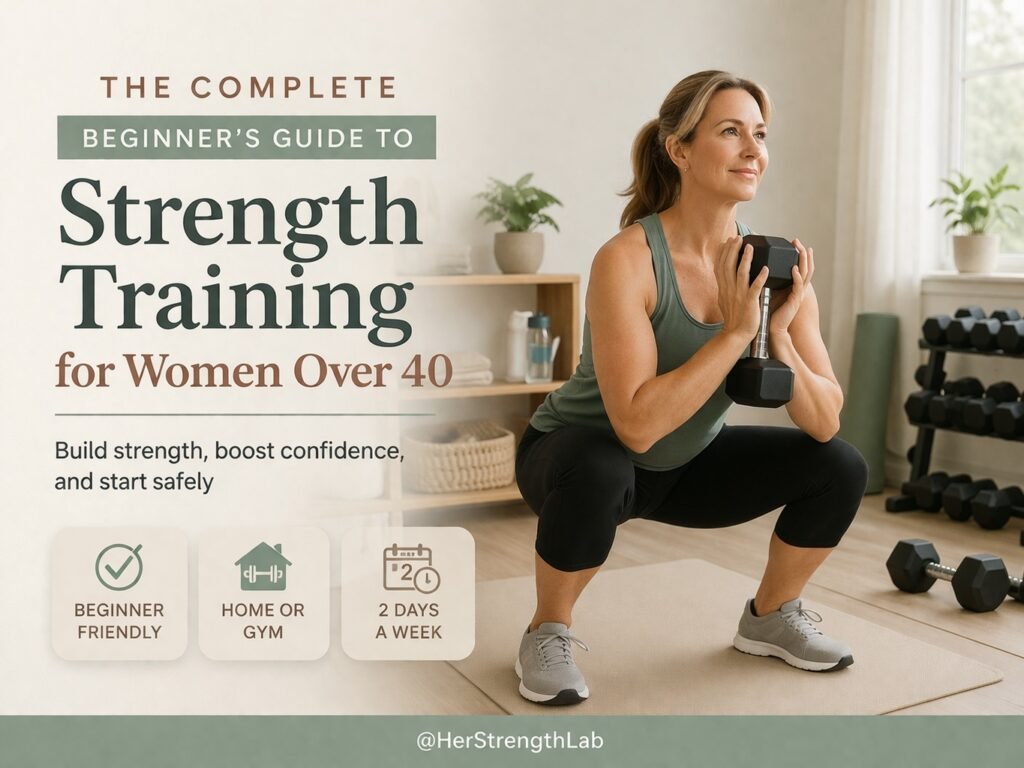
Everything you need to start a Complete Beginner’s Guide to Strength Training for Women Over 40 — from why your body responds differently after 40, to the exact exercises, schedules, and gear that will get you results. No prior gym experience required.
Here’s a number worth sitting with: you’re losing 3–8% of your muscle mass every decade starting at age 30. By the time you hit 40, that process is well underway — and if you’re not actively fighting it, it quietly accelerates.
That’s not meant to scare you. It’s meant to make the case for something that a growing body of research is now calling non-negotiable for women in their 40s: strength training.
Not cardio. Not yoga (though both have their place). Weight-bearing, muscle-building resistance training — the kind that tells your body to hold onto what it has, build more, protect your bones, and regulate your hormones. The kind that, according to a 2024 study, makes women who do it two to three times per week significantly more likely to live longer and have a lower risk of dying from heart disease compared to women who don’t.
If you’ve never lifted weights before, or if you stopped years ago and feel like a complete beginner, this guide is for you. We’re going to cover why this works, how to actually start, and what to realistically expect — without the noise.
Why Strength Training Works Differently After 40
Forty isn’t a cliff edge. But it does mark a shift — one that changes how you should approach exercise if you want to get results.
Around your mid-to-late 30s, estrogen and progesterone begin their slow decline. This isn’t just a fertility story. These hormones play a direct role in how your body builds and maintains muscle, manages inflammation, and recovers from exercise. Lower estrogen means:
- Slower muscle protein synthesis — it takes your muscles longer to repair and rebuild after training
- Increased sensitivity to inflammation — recovery takes more time than it used to
- Greater fat redistribution — particularly around the abdomen, as your body becomes more insulin-sensitive
- Reduced joint lubrication — which is why some movements that felt fine at 30 start to ache at 45
The answer to all of this isn’t to train less. It’s to train smarter. Compound movements with adequate resistance, appropriate volume, and enough recovery time — that combination directly counters every one of those shifts.
Training after 40 isn’t about intensity for its own sake. It’s about applying consistent, progressive resistance to the right movement patterns — with enough recovery between sessions that your body can actually respond to the stimulus.
The good news, and this is often underappreciated: women over 40 respond to resistance training remarkably well. A 2023 study published in the Journal of Cachexia, Sarcopenia and Muscle found that regular strength training can actually reverse age-related changes in muscle tissue at a cellular level — researchers described it as epigenetic reprogramming of muscle stem cells. Your muscles don’t know how old you are. They respond to load.
Muscle mass lost per decade without resistance training
Lower all-cause mortality when combining strength + cardio
Average increase in resting metabolic rate after 9 months of lifting
Women rate strength training as the most empowering exercise type over running (2023 study)
What You Actually Gain — Backed by Research
Let’s be specific. Because “feel better” and “get stronger” doesn’t capture what the research is actually showing about what happens to women over 40 who lift consistently.
Stronger, denser bones
Bone density peaks in your late 20s and declines from there. After menopause, the rate accelerates. But resistance training is one of the most effective tools we have to slow — and in some cases reverse — that decline.
A 2025 systematic review and meta-analysis found that resistance training at moderate-to-high loads (roughly 65–80% of your max effort) performed 3 times per week showed the most consistent improvements in bone mineral density at the spine and hip in post-menopausal women. You don’t need to lift at your absolute limit. You need to lift challengingly and do it consistently.
A metabolism that works for you
One of the most frustrating things about gaining weight after 40 is that your diet hasn’t changed, but your body clearly has. Part of that is hormonal. Part of it is muscle loss itself — because muscle is metabolically active tissue that burns calories even at rest.
A nine-month resistance training study found an average increase in resting metabolic rate of about 5%, roughly 158 additional calories burned per day — without changing diet. That compounds significantly over time.
Better heart health
A 2024 randomized controlled trial had 73 sedentary women complete 24 weeks of full-body resistance training. The results, measured by tissue Doppler echocardiography, showed meaningful improvements in multiple heart function metrics including left ventricular ejection fraction and significant reductions in end-systolic volume. Three sessions per week. Eight exercises per session. That was all it took.
Mental health and mood
Two large meta-analyses published in 2024 — covering women from their teens through post-menopause — reported significant reductions in both anxiety and depressive symptoms with regular strength training. Another 2024 meta-analysis of 218 studies concluded that strength training should be considered a core treatment for mild to moderate depression, alongside psychotherapy and medication.
This isn’t a soft benefit. It’s one of the most well-documented outcomes in the research.
Physical independence you can count on
This one tends to land differently as you get older. Strength training isn’t just about how you look. It’s about whether you can carry your own groceries at 70, get up off the floor without help at 65, and travel on your own terms at 80.
A University of Exeter study published in Medicine & Science in Sports & Exercise found that resistance training for women aged 40–60 specifically maintains hip strength, dynamic balance, flexibility, and lean body mass through the menopause transition — precisely when those attributes are at greatest risk.
3 Myths That Keep Women From Starting
Before we get into the practical stuff, let’s dispatch the beliefs that tend to hold women back. You’ve probably heard at least one of these.
Myth 1: “I’ll get bulky”
This is the most persistent one, and it’s based on a fundamental misunderstanding of female physiology.
Women have roughly 15–20 times less testosterone than men. Testosterone is the primary anabolic hormone behind the kind of muscle growth that produces a noticeably “bulky” physique. Even women who train specifically and deliberately for muscle size — with high volume, caloric surplus, and years of consistent effort — typically add modest amounts of muscle. The bodybuilders you might be imagining typically use hormonal assistance.
What most women actually experience from regular strength training: a leaner, more defined shape, improved posture, and clothes that fit differently — in a good way.
Myth 2: “It’s too late to start”
The research doesn’t support this at all. Studies have shown meaningful muscle and strength gains in women starting resistance training in their 50s, 60s, and even 70s. Your muscles respond to progressive load regardless of age — the mechanism doesn’t turn off.
Yes, recovery takes longer as you age. Yes, some modifications may be appropriate for joint health. But “it’s too late” is simply not what the data says.
Myth 3: “I need to master cardio first”
Cardio and strength training aren’t a hierarchy. They’re different tools with different effects. Both matter. But for women over 40 specifically, strength training addresses more of the physiological concerns — bone density, muscle preservation, metabolic rate, insulin sensitivity — than cardio alone.
The optimal approach combines both. But if you’re choosing where to start, the case for beginning with strength training first is genuinely strong.
A study comparing all-cause mortality outcomes found that aerobic exercise alone reduces risk by 16%, strength training alone reduces it by 21%, but doing both together reduces it by 29%. You want both — but strength training carries slightly more benefit when done in isolation.
Strength Training For Woman Over 40
How to Start: The 5 Movements Every Beginner Needs
Before weights, before programs, before anything else — you need movement patterns. Every effective strength training program, for women of any age, is built on five foundational movements. These are the patterns your body needs to function well and the ones that produce the most return per session.
Master these five. Everything else is a variation.
| Pattern | What It Trains | Beginner Exercise | Start With |
|---|---|---|---|
| Squat | Quads, glutes, core | Goblet squat (dumbbell or kettlebell held at chest) | Bodyweight, then 8–15 lbs |
| Hip Hinge | Hamstrings, glutes, lower back | Romanian deadlift (dumbbells) | 10–15 lbs per hand |
| Push | Chest, shoulders, triceps | Dumbbell floor press or incline press | 8–12 lbs per hand |
| Pull | Back, biceps, rear delts | Single-arm dumbbell row | 10–15 lbs |
| Carry / Brace | Core stability, grip, posture | Farmer’s carry (walk holding dumbbells at sides) | 15–20 lbs per hand |
A few notes on execution:
- Start lighter than you think you need to. Form first, weight second. Every time.
- Control the eccentric (the lowering phase). The down phase of a squat, the lowering of the weight in a press — this is where much of the muscle-building stimulus comes from. Aim for 2–3 seconds down.
- Breathe. Exhale on the exertion (the hard part), inhale on the easier phase. Don’t hold your breath through sets.
- If something hurts — not burns, not feels challenging, but hurts — stop and modify. Pain and effort are not the same thing. Joint pain, especially in the knees, hips, or shoulders, is a signal to adjust, not push through.
Some movements that are common in general fitness advice — heavy barbell back squats, behind-the-neck presses, full range deep lunges — can place significant stress on joints that are managing the effects of reduced estrogen and cartilage changes. This doesn’t mean avoiding these movements forever. It means the dumbbell and resistance band variations recommended above are smarter starting points. Build the foundation first.
Your First 12 Weeks: A Simple, Realistic Plan
The American College of Sports Medicine recommends 2–3 strength training sessions per week for beginners. That’s the sweet spot: enough frequency to produce adaptation, enough rest to allow recovery.
Here’s how to structure your first three months. The principle is simple: you do less than you think you can in week one, and gradually add more. This is called progressive overload — the single most important concept in strength training, and the one most beginners violate by doing too much too soon.
Phase 1: Weeks 1–4 — Form & Foundation
Three sessions per week, full body each time. Keep volume low and focus entirely on movement quality.
Goblet squat 3×10 · Dumbbell row 3×10/side · Dumbbell floor press 3×10 · Farmer’s carry 3×20m
20–30 minutes easy walking. No lifting.
Romanian deadlift 3×10 · Dumbbell shoulder press 3×10 · Resistance band pull-apart 3×15 · Glute bridge 3×12
Gentle stretching or yoga if desired.
Same as Monday. Focus on moving better than last time — not heavier.
Walking, swimming, yoga — keep it easy.
Phase 2: Weeks 5–8 — Add Load
Once movements feel natural, increase weight by small increments — 2.5–5 lbs per exercise. The rule: if you can complete all sets and reps with good form and it still feels manageable, you’re ready to add weight. If the last 2 reps are genuinely hard, stay there another week.
Add one more exercise per session: a lunge variation (reverse lunge is gentler on knees than forward lunge), a core exercise like a dead bug or plank, and a calf raise for bone density in the lower leg.
Phase 3: Weeks 9–12 — Build Consistency
By this point, you should feel noticeably different — better posture, stronger daily movements (stairs, carrying things), and improved energy. This is when the habit is forming.
Increase to 4 sets per exercise on your key movements. Consider splitting into upper/lower days if you want to train 4 days per week. And start tracking your weights — even in a notes app. Progress only becomes visible when you measure it.
Weeks 1–3: You’ll feel sore. Especially in places you’ve never felt sore before. This is normal. Stay hydrated, sleep well, and keep moving on your rest days — light walking accelerates recovery.
Weeks 4–6: The soreness gets less intense. Energy starts improving. You’ll notice you’re getting stronger — weights that felt challenging are now manageable.
Weeks 8–12: Visible changes in muscle tone and body composition begin. Posture improves. Clothes fit differently. The habit becomes something you protect rather than something you push yourself to do.
What Equipment You Actually Need (And What to Skip)
You don’t need a home gym or a fancy gym membership to do this well. Here’s what genuinely matters:
Essential (spend here first)
- A set of adjustable dumbbells or 3 fixed pairs — something light (8–10 lbs), medium (15–20 lbs), and heavier (25–35 lbs). You’ll graduate through these quickly. Adjustable dumbbells are more economical long-term.
- A resistance band set — loop bands for lower body, long bands for upper body. Inexpensive, versatile, and excellent for joint-friendly loading.
- A mat — for floor work. Worth the investment for comfort and hygiene.
Useful but not essential
- A kettlebell (one moderate weight — great for goblet squats and carries)
- A bench or sturdy chair (for incline pressing, step-ups)
- A foam roller (for recovery — more useful than most supplements)
Skip (for now)
- Barbells and squat racks — excellent tools, but not what beginners need to prioritize
- Most machines — useful, but not necessary and not ideal for building functional strength
- Wrist wraps, lifting belts, knee sleeves — you’ll know when and if you need these; it’s not week one
Bowflex SelectTech 552 Adjustable Dumbbells
Adjusts from 5 to 52 lbs in 2.5 lb increments — the best single investment for home strength training. We tested these for 12 weeks with women of varying fitness levels. The adjustment mechanism is smooth, the build quality holds up, and the weight range covers everything a beginner through intermediate lifter needs.
Recovery: The Part Most Beginners Ignore
Training is the stimulus. Recovery is where the adaptation actually happens. This distinction becomes more important — not less — as you age.
After 40, your body’s recovery capacity changes. Muscle protein synthesis in response to exercise is slightly blunted compared to your 20s, which means the inputs around training matter more. The big three:
1. Protein — more than you think
The standard recommendation of 0.8g of protein per kg of bodyweight is a minimum for general health — not a target for women trying to build muscle. Current research for active women over 40 suggests closer to 1.6–2.0g per kg of bodyweight per day (roughly 0.7–0.9g per pound). Prioritize high-quality sources: eggs, lean meat, Greek yogurt, cottage cheese, legumes. Distribute it across meals rather than loading it all at dinner.
2. Sleep — more than you’re getting
Growth hormone — the hormone most responsible for tissue repair after exercise — is released primarily during deep sleep. Chronic sleep deprivation doesn’t just leave you tired; it directly undermines your body’s ability to recover from training. Aim for 7–9 hours. Treat this as part of your training, not separate from it.
3. Rest days — not optional
Two to three sessions per week for beginners isn’t a limitation. It’s the optimal frequency. The sessions stimulate adaptation; the rest days are where it happens. If you’re feeling genuinely sore — not just the typical post-workout tightness, but actual joint soreness or sharp discomfort — take an extra rest day. Your body is communicating clearly. Listen to it.
Three good sessions per week + adequate protein + quality sleep = consistent progress. Three sessions per week + poor sleep + low protein = frustrating stagnation. The training is the easy part. The habits around it are what determine the results.
Frequently Asked Questions
Yes — and this demographic responds well. Research consistently shows that women in their 40s, 50s, and beyond build muscle and strength effectively with resistance training. Starting with 2–3 sessions per week of basic compound movements is the right approach. No prior experience required.
Two to three non-consecutive days per week. This is the ACSM recommendation for beginners and it’s well-supported by the research. More is not better when you’re starting out. The recovery time between sessions is when your muscles actually adapt and get stronger.
No. Women don’t produce enough testosterone to build large amounts of muscle without specific, sustained, and deliberate effort over many years. Regular strength training typically produces a leaner, more defined physique, not a bulky one. This is one of the most persistent myths in women’s fitness, and it’s consistently unsupported by both research and real-world experience.
Focus on five foundational movement patterns: squat (start with goblet squat), hip hinge (Romanian deadlift), push (dumbbell press), pull (dumbbell row), and carry (farmer’s walk or suitcase carry). Master these movement patterns before adding more variety. They cover the majority of your muscle mass and produce the best returns per session.
Most women notice improved energy, better posture, and functional strength gains within 2–3 weeks. Visible changes in body composition typically begin at 8–12 weeks with consistent training. Full aesthetic transformation — the kind worth photographing — generally takes 6+ months of consistent work. The timeline is longer than social media implies, but the results are more durable.
Not only safe — it’s specifically recommended. Resistance training directly addresses many of the physiological changes associated with perimenopause and menopause: bone density loss, muscle loss, metabolic slowdown, and mood changes. A University of Exeter study published in Medicine & Science in Sports & Exercise found that resistance training specifically maintains hip strength, balance, and lean mass through the menopause transition. Consult your doctor if you have specific health conditions, but the research supports this as beneficial rather than risky.
Home training works well for the beginner phase. A set of adjustable dumbbells, a resistance band set, and a mat cover the vast majority of what you need for your first 12 weeks. A gym becomes more valuable once you’ve outgrown home equipment — particularly if you want to progress to barbell training. But starting at home removes the access barrier and is genuinely effective.
See the Equipment We Actually Recommend
Our team has tested every major dumbbell set, resistance band, and home gym system recommended for women starting strength training after 40. No fluff — just what works, at every budget.
Affiliate disclosure: Some links in this article are affiliate links. If you purchase through them, we earn a small commission at no additional cost to you. This never influences our editorial recommendations — all picks are based on independent testing and research. See our full affiliate disclosure policy.
Medical disclaimer: This article is for informational purposes only and does not constitute medical advice. Consult your healthcare provider before beginning a new exercise program, particularly if you have existing health conditions, joint issues, or are managing symptoms of perimenopause or menopause.