


This is the best home gym equipment for woman over 40: You don’t need a full commercial gym in your living room. You need the right seven pieces — chosen specifically for how women over 40 actually train. This guide tells you exactly what to buy, in what order, and why each piece earns its place.
| # | Equipment | Our Pick | Priority | Space Needed | Rating |
|---|---|---|---|---|---|
| 1 | Adjustable Dumbbells | Upgraded Kettlebell Connector Set | 🔴 Buy First | Minimal | ★★★★½ |
| 2 | Resistance Bands | Handle Set 10–100 lbs | 🔴 Buy First | None | ★★★★ |
| 3 | Exercise Mat | AmazonBasics Extra Thick | 🔴 Buy First | Minimal | ★★★★ |
| 4 | Foam Roller | Chirp Wheel Roller | 🟡 Buy Second | None | ★★★★½ |
| 5 | Weight Bench | Finer Form Multi-Functional | 🟡 Buy Second | Moderate | ★★★★ |
| 6 | Pull-Up Bar | KAKICLAY Multi-Grip | 🟢 Buy Third | None (doorframe) | ★★★★ |
| 7 | Kettlebell | Kure Fit Adjustable | 🟢 Buy Third | Minimal | ★★★★ |
What You Actually Need vs What Gets Marketed to You
The fitness equipment industry loves to sell women over 40 on complexity — cable machines, squat racks, cardio equipment, Smith machines. Walk into a fitness showroom and you’ll leave feeling like you need $8,000 and a 400 square foot room to train properly at home.
You don’t. Not even close.
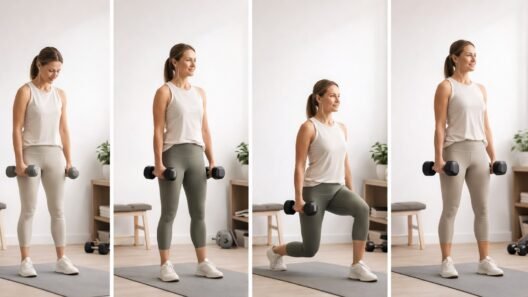
The exercises that produce the most meaningful results for women over 40 — the squats, hinges, rows, presses, and carries we talk about in our lifting guide — require nothing more than a modest set of dumbbells, some floor space, and a mat. Everything else in this list is an upgrade that expands your options and improves your experience. None of it is mandatory to start.
This guide is organized around that reality. The first three items in this list are your foundation — the minimum viable home gym that will cover everything in our beginner’s program. The remaining four are smart additions that come as you progress and your training evolves.
You can build a genuinely effective home gym — one that covers 90% of what you’ll train in your first 18 months — for under $150. The full setup in this guide, with all seven pieces, comes in well under $500. Compare that to one year of a gym membership.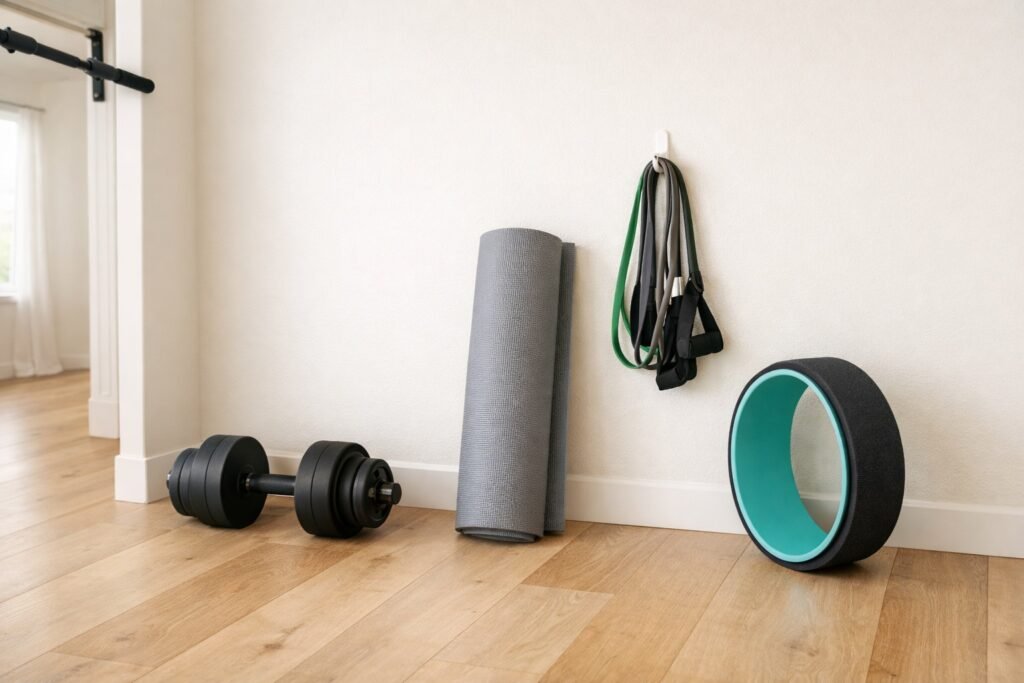
The Order to Buy — Start Here, Upgrade Later
Adjustable dumbbells + resistance bands + exercise mat. These three cover every exercise in our beginner program. Start training within days of purchase.
Foam roller + weight bench. The roller improves recovery immediately. The bench unlocks pressing exercises and dramatically expands your exercise options.
Pull-up bar + adjustable kettlebell. By now you know your training is sticking. These two add movement patterns you can’t replicate with dumbbells alone.
Best Home Gym Equipment for Women Over 40
1. Adjustable Dumbbells — The Foundation of Everything
Specs at a Glance
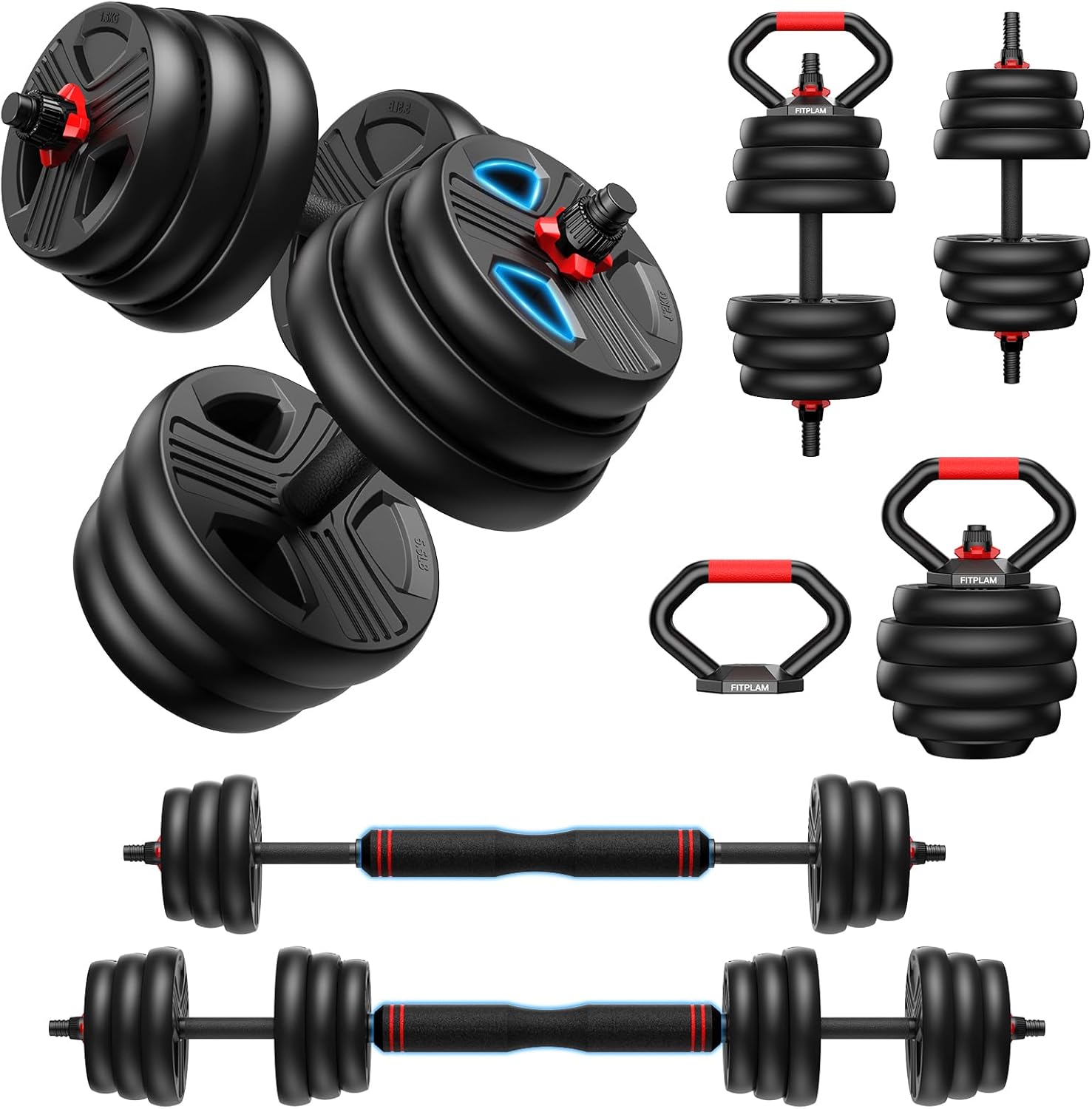
Weight range: 20 / 30 / 40 / 55 / 70 / 80 / 90 lbs total
Modes: Dumbbell / Barbell / Kettlebell
Bars: ABS non-slip, upgraded design
Connector bar foam: 20mm thick, curved design
Weight increments: 7 configurations to 90 lbs total
Click image to check price on Amazon
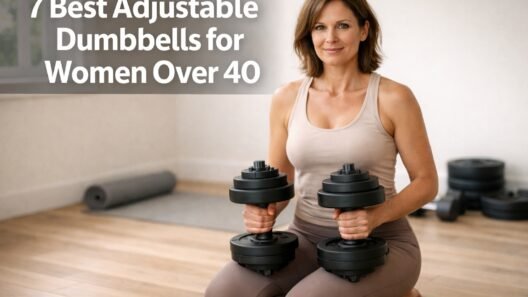
If you only ever buy one piece of home gym equipment, make it adjustable dumbbells. Every exercise that matters — goblet squats, Romanian deadlifts, rows, presses, carries — is done with dumbbells. Nothing else comes close to the return on investment.
This upgraded set earns its place as the foundation pick for a specific reason: seven weight configurations running from 20 lbs all the way up to 90 lbs total. That range covers a complete beginner who’s never touched a dumbbell and an intermediate lifter who’s been training consistently for a year and a half. You won’t outgrow it quickly — and that’s exactly what you want from a foundation piece.
The 3-in-1 design (dumbbells, barbell, kettlebell) is genuinely useful at this price point. The 20mm foam-padded connector bar is thick enough to sit comfortably on the neck during barbell work, and the connector transforms the set for exercises like bent-over rows and Romanian deadlifts at heavier loads. The upgraded ABS bars have a noticeably better grip texture than the standard version — important when your hands are sweaty mid-set.
At seven weight configurations, this set also gives you more progression steps than most competitors. Small increments matter for beginners — jumping from 20 lbs to 40 lbs is too large a step for most exercises early on. The intermediate stops keep progressive overload manageable.
What we like
- Seven weight configurations — the widest range in this category for the price
- 90 lb total maximum — covers beginner through solid-intermediate training
- Upgraded grip bars — noticeably better than standard ABS alternatives
- 3-in-1 functionality adds barbell and kettlebell modes without extra cost
- 20mm foam connector — comfortable enough for actual barbell work
What to know before buying
- Manual plate loading — slower weight changes than dial-based systems
- Check locking nuts before each heavy set — standard for this category
- Ships heavy at higher configurations — plan delivery and storage in advance
2. Resistance Bands — The Joint-Friendly Partner to Dumbbells
Specs at a Glance
Type: Tube bands with cushioned handles
Resistance levels: 5 levels — 10 to 100 lbs
Accessories: Door anchor, storage pouch
Target users: Women, beginners, physical therapy
Best for: Upper body, cable-style movements, PT exercises

Click image to check price on Amazon
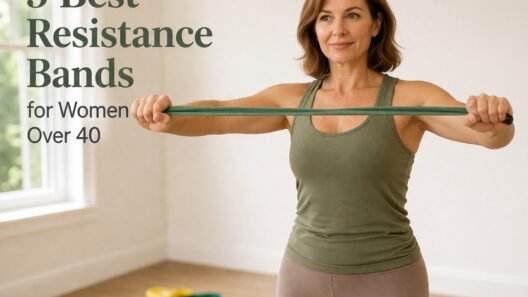
Resistance bands belong in every home gym alongside dumbbells — not instead of them. They load your joints differently, provide resistance through the full range of motion, and allow you to train muscle patterns that dumbbells can’t target as effectively. The lateral raise with a band, the face pull using the door anchor, the banded hip thrust — these are movements where bands outperform dumbbells.
This handle set is designed with women in mind from the start. The resistance levels begin genuinely light at 10 lbs — appropriate for anyone starting from zero, recovering from injury, or learning new movement patterns. The cushioned handles reduce hand fatigue meaningfully during longer sets, which matters when you’re building the habit of consistent training.
The door anchor is what makes this set a home gym essential rather than a mobility accessory. Attach it at different heights on the door — top, middle, and floor level — and you’ve effectively created a cable machine that covers lat pulldowns, seated rows, face pulls, and cable kickbacks. That’s a lot of exercise variety from a set that weighs under a pound and stores in a pouch.
What we like
- Designed specifically for women — light starting resistance, appropriate progression
- Cushioned handles reduce hand fatigue during multi-set sessions
- Door anchor creates a cable machine effect at three heights
- Fits in a drawer — the most space-efficient piece of equipment in this entire guide
- Excellent for physical therapy exercises and joint-sensitive training
What to know before buying
- 100 lbs is the combined maximum — individual bands are lighter
- Door anchor is adequate for moderate resistance — heavy rowing loads need a sturdier option
3. Exercise Mat — The One People Always Skip and Always Regret
Specs at a Glance
Thickness: Extra thick — 1/2 inch (13mm)
Dimensions: 72″ × 24″ — standard full length
Material: High-density NBR foam
Surface: Non-slip texture both sides
Portability: Carrying strap included
Best for: Floor work, stretching, core exercises

Click image to check price on Amazon
A mat is the piece of equipment everyone thinks they don’t need until their knees are bruised from floor presses and their wrists hurt from planking on hardwood. Don’t be that person.
The AmazonBasics Extra Thick does exactly what an exercise mat needs to do — provides genuine cushioning for floor work, stays put on hardwood and tile, and doesn’t cost enough to make skipping it a rational decision. At half an inch thick, it’s meaningfully more cushioning than standard yoga mats. That extra padding is not irrelevant after 40, when kneeling on hard floors during exercises like dumbbell rows starts to actually bother your joints.
The NBR foam holds up well under the kind of use a home gym puts it through: floor presses, dead bugs, hip thrusts, planks, stretching. It doesn’t compress down to nothing after six months the way cheaper foam does. The non-slip surface on both sides keeps it from sliding on smooth floors and keeps you from sliding on it — both matter during dynamic exercises.
The carrying strap is a nice touch if you want to take this to a park or outdoor space — resistance band training outdoors is a genuinely enjoyable warm-weather option.
What we like
- Extra thick at 1/2 inch — noticeably more protective than standard yoga mat thickness
- Non-slip on both sides — stays put on hardwood and tile during dynamic movements
- NBR foam holds density over time — doesn’t compress flat with regular use
- Carrying strap — useful for outdoor training or storage
- The most affordable essential piece in this entire guide
What to know before buying
- NBR foam has a slight chemical smell when new — air it out for 24 hours before first use
- Standard 72″ length is sufficient for most women; tall women may prefer the 74″ option
4. Chirp Foam Roller — Your Recovery Secret Weapon
Specs at a Glance
Type: Wheel-style foam roller (not cylinder)
Available sizes: 4″, 6″, 10″, 12″ diameter
Width: 5 inches — designed for spinal alignment
Design feature: Central spinal canal groove
Weight limit: 500 lbs
Best for: Back pain relief, spinal mobility, post-workout recovery

Click image to check price on Amazon
Recovery matters more after 40 — and the Chirp Wheel is the most effective recovery tool in this entire guide for a specific reason: it actually targets your back.
Standard foam rollers are cylinders. When you roll your back on a cylinder, the foam presses directly on your spine, which is uncomfortable and can actually put unhelpful pressure on your vertebrae. The Chirp Wheel solves this with a central groove that runs down the center of the tread — it aligns your spine in the groove while the foam presses against the erector muscles on either side. You get the full muscle release without compressing the spine itself. The difference in feel is immediate and significant.
For women over 40 who sit at desks, have tight hip flexors from daily life, or experience upper back tension from the forward posture that develops with age — this wheel is genuinely effective. Over 600 purchases per month on Amazon and a reputation that started on Shark Tank aren’t accidents. The people who buy it use it daily, which is exactly what you want from a recovery tool.
The 10″ wheel (medium) is the best starting size for most women — firm enough to provide meaningful release, forgiving enough not to feel brutal on your first session. The 4″ is more intense and better for experienced users who want deeper tissue work.
What we like
- Spinal canal groove — targets back muscles without vertebral compression
- More effective for back pain and thoracic mobility than standard foam cylinders
- 500 lb weight limit — built to hold up under body weight loading
- Multiple size options — start at 10″ medium and go smaller for more intensity
- Compact — stores easily, can travel with you
What to know before buying
- Not a traditional foam roller replacement for leg rolling — best for back and spine specifically
- Takes 1–2 sessions to find your ideal body position — follow the included instructions
- The firm plastic core means it feels intense initially — start with the 10″ or 12″ for gentler pressure
5. Finer Form Weight Bench — The Game Changer for Home Training
Specs at a Glance
Positions: 8 back pad + 3 seat + 8 support pad settings
Modes: Flat / Incline / Decline / Hyperextension / Roman Chair / Sit-Up Bench
Weight capacity: 1,000 lbs
Frame: Heavy-duty steel, triangular base
Mobility: Wheels for repositioning
Warranty: 1 year manufacturer warranty
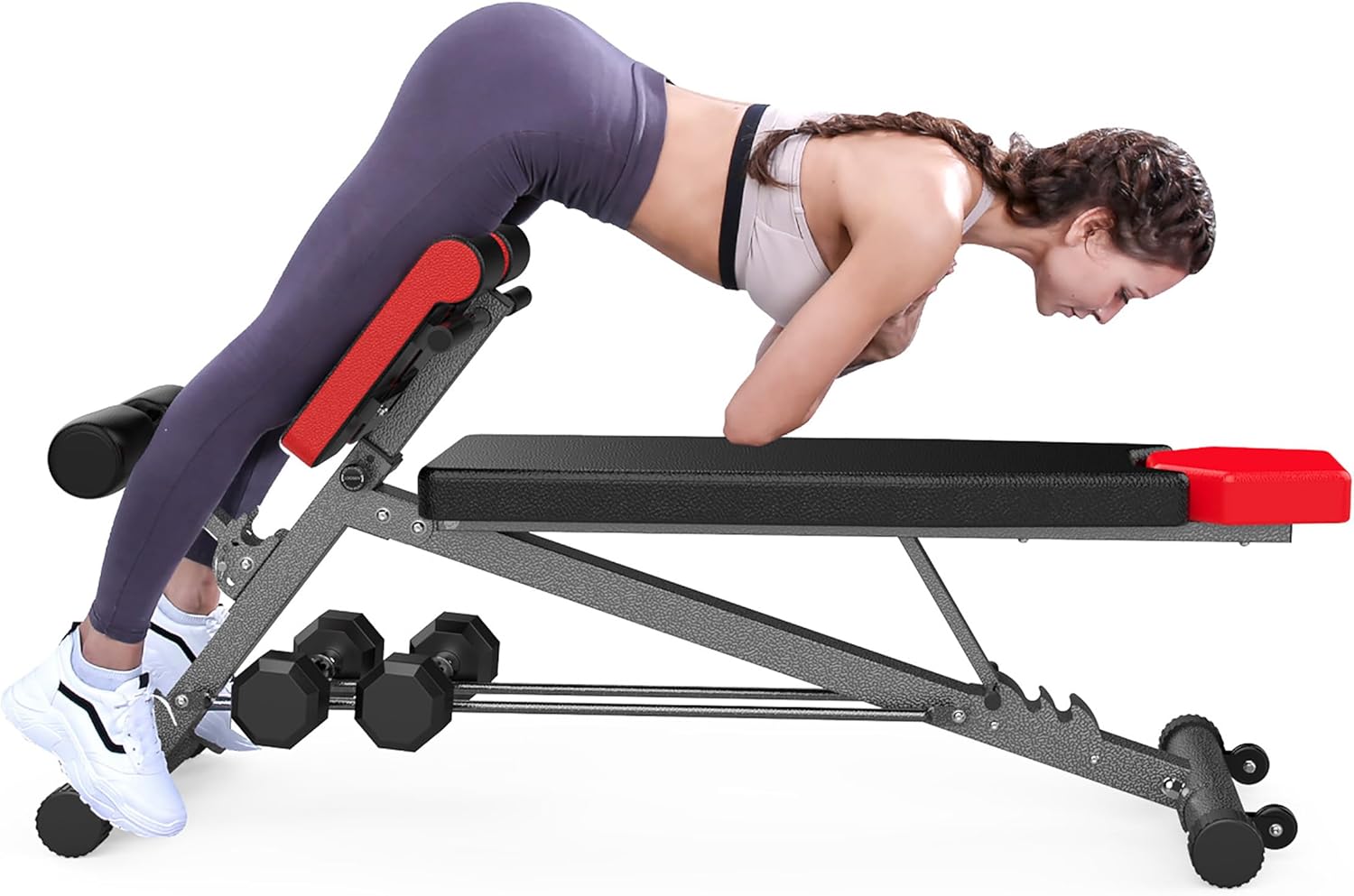
Click image to check price on Amazon
A weight bench transforms what’s possible in a home gym. Before a bench, you’re doing floor presses and seated dumbbell work. After a bench, you have incline pressing, decline work, seated rows, step-ups, Bulgarian split squats, and hyperextensions. One piece of furniture doubles your exercise options.
The Finer Form earns its recommendation because it does something most benches in its price range don’t: it converts into a hyperextension station. This matters for women over 40 more than it might sound. Back extensions on the hyperextension setting directly strengthen the erector spinae — the muscles most responsible for lower back support and posture. Chiropractors consistently list this as one of their top recommended home exercises. Most benches can’t do it. This one can.
The 8 back pad positions cover everything from a steep decline through six incline angles to flat — giving you a genuinely versatile pressing surface rather than the two or three positions most adjustable benches offer. The 1,000 lb tested weight capacity is far beyond what anyone in this context needs, but it tells you the steel frame is heavy-duty rather than flimsy. The triangular base design prevents rocking, which is critical when you have weights overhead.
Honest note from customer reviews: assembly takes 30–40 minutes and the instructions could be clearer. Some users note mild wobble on certain floor surfaces. These are real callouts — not dealbreakers for a home gym bench in this price range, but worth knowing. If you’re on perfectly level flooring and patient with the setup, this bench performs well above its price point.
What we like
- Hyperextension station — the feature most benches at this price don’t offer, and one that directly benefits lower back health
- 8 back pad positions — true versatility, not just flat/incline/decline
- 1,000 lb tested capacity — heavy-duty steel frame with genuine stability
- Wheels for repositioning — easy to move around small spaces
- Free workout chart included — 25 exercises to get you started immediately
- 6-in-1 function replaces multiple separate pieces of equipment
What to know before buying
- Assembly takes 30–40 minutes — set aside proper time and follow instructions carefully
- Some wobble reported on unlevel floors — use rubber mats under the feet if needed
- Not commercial gym quality — excellent for home use, but factor in 1–3 year lifespan for regular heavy use
6. KAKICLAY Pull-Up Bar — Back Strength Without a Rack
Specs at a Glance
Type: Doorframe pull-up bar — no screws, no drilling
Fits doors: 21.65″ to 36.22″ wide
Weight limit: 440 lbs
Grip options: Multiple — wide, narrow, neutral, angled
Extras: Suspension straps included
Design: Foldable for storage, silicone door protectors
Patent: US Patent No. US 11,964,180

Click image to check price on Amazon
Let me be direct: most beginner women won’t be doing full pull-ups in month one or even month three. That’s completely normal. But the pull-up bar earns a place in a home gym because the movement pattern it trains — vertical pulling — is one of the most important for posture, upper back strength, and shoulder health. You get there through assisted variations and band-supported work long before you can do an unassisted rep.
The KAKICLAY stands out in a crowded doorframe bar category because of the US-patented larger hook design. Standard doorframe pull-up bars work on leverage — your body weight pressing the bar against the frame. But cheap versions slip, damage door frames, and feel unstable enough to make you not trust them. The KAKICLAY’s enlarged hooks, 2025-upgraded silicone door protectors, and 440 lb capacity give you the confidence to hang from it without second-guessing the setup.
The multiple grip positions are a genuine feature, not just a marketing bullet point. Wide grip targets the lats. Neutral grip (palms facing each other) is easier on the wrists and shoulders — critical for women over 40 managing any wrist or elbow sensitivity. The angled ergonomic grips protect the wrist on pull-up variations. And the included suspension straps let you use this for TRX-style bodyweight rows — a fantastic pulling exercise for women who aren’t yet doing full pull-ups.
Folds flat in seconds. No tools, no screws, no permanent wall modification — important for renters.
What we like
- US-patented larger hooks — significantly more stable than standard doorframe bars
- Silicone door protectors — no marks, no damage to the frame
- Multiple grip options including wrist-friendly neutral and angled grips
- Suspension straps included — enables bodyweight rows before full pull-ups are achievable
- 440 lb capacity — built with real safety margins
- Folds flat, no drilling — apartment-friendly
What to know before buying
- Check your door frame dimensions before purchasing — fits 21.65″ to 36.22″ width
- Not compatible with hollow plasterboard walls — needs solid door frame structure
- Door depth requirement: max 8.27″ (21cm)
7. Kure Fit Adjustable Kettlebell — The Versatile All-Rounder
Specs at a Glance
Type: Adjustable kettlebell
Use case: Full-body functional training, swings, carries
Best for: Kettlebell-specific movements + conditioning
Who needs it: Women ready to progress beyond basic dumbbells

Click image to check price on Amazon
A kettlebell does things a dumbbell can’t. The offset weight center changes how the load sits in your hand, which creates different muscle activation patterns — particularly through the forearm, wrist, and shoulder stabilizers. Kettlebell swings, the Turkish get-up, goblet squats with a kettlebell, single-arm carries — these are movements that build a specific kind of functional strength that translates directly to real-world demands.
The adjustable design makes sense here because your ideal kettlebell weight changes as you get stronger — and fixed kettlebells are expensive per unit. One adjustable bell that grows with your training is the smarter investment, especially when you’re still establishing your home gym.
Why is this a Phase 3 purchase? Because kettlebell movements — especially the swing — have a learning curve. The hip hinge mechanics need to be solid before you add the dynamic element of a swing. Spend your first 8–12 weeks on the foundational dumbbell movements in our lifting guide, build that hip hinge pattern, and then introduce the kettlebell. The carry-over from good dumbbell Romanian deadlifts to kettlebell swings is immediate and satisfying.
What we like
- Adjustable weight — grows with your training without buying multiple bells
- Enables kettlebell-specific movements dumbbells can’t replicate
- Builds grip strength, shoulder stability, and hip power simultaneously
- Compact — one piece of equipment, enormous exercise variety
- Perfect progression tool for women who’ve established their dumbbell foundation
What to know before buying
- Learn the hip hinge pattern with dumbbells first before using for swings
- Kettlebell swings and cleans have technique requirements — watch instruction videos before your first session
- Not a week-one purchase — earn this one after your foundation is built
Budget Tiers: What to Buy at Every Price Point
Not everyone wants to build the full setup at once. Here’s exactly what to prioritize at different investment levels:
Under $100 — The Absolute Minimum
Adjustable dumbbells (starting weight + 1–2 heavier configurations) + exercise mat. This covers every foundational movement in our beginner’s program. You can do goblet squats, RDLs, floor presses, rows, and carries with this setup. It’s not glamorous, but it works.
$100–$200 — The Smart Starter
Adjustable dumbbells + resistance bands + exercise mat. The bands add the door anchor cable work, upper body variety, and joint-friendly loading that turns a basic setup into a genuinely comprehensive one. This is where most beginners should start.
$200–$350 — The Complete Beginner Setup
Everything in the $100–$200 tier + Chirp Wheel roller + pull-up bar. Recovery is taken care of, upper body vertical pulling is possible, and you have everything needed to run a serious 12-week beginner program without missing anything important.
$350–$500 — The Full Setup
Everything above + weight bench + adjustable kettlebell. At this point your home gym covers every movement pattern, every major muscle group, and every progression step you’ll need for the next two years of training. This is where the equipment stops being the limiting factor and your effort and consistency take over.
The best equipment is the equipment you actually use. A $150 dumbbell setup that you train on three times per week beats a $2,000 home gym that sits in the corner collecting guilt. Start with what you need. Add as the habit grows. Don’t let equipment decisions become a reason to delay starting.
Setting Up Your Space: It Doesn’t Need to Be a Room
The most common thing I hear from women who want to train at home: “I don’t have space.” In most cases, they’re wrong — they have space, they just haven’t decided to use it.
The Phase 1 and Phase 2 setup requires a floor area of approximately 6 feet × 8 feet during a session. That’s the footprint of a queen bed. You don’t need a dedicated room — you need a corner, a wall, and the willingness to move a coffee table for 40 minutes three times a week.
Adding the bench does require more dedicated floor space — roughly 3 feet × 6 feet to use comfortably. But the bench has wheels for repositioning, so it can be pushed to a wall when not in use.
The pull-up bar lives in a doorframe. It takes zero floor space. The kettlebell and the resistance bands store in a corner or a drawer. The mat rolls up and leans against a wall. The Chirp Wheel stands upright in a corner. The entire Phase 1–2 setup stores in a space smaller than a single kitchen cabinet.
Frequently Asked Questions
Adjustable dumbbells. They’re the foundation that every other piece of equipment builds on. Every foundational movement pattern — squat, hinge, push, pull, carry — can be trained with dumbbells. If you can only buy one thing, buy dumbbells. Everything else adds variety and progression options, but dumbbells cover the essentials.
Not for the first 12–18 months of training. The home gym setup in this guide covers every movement pattern needed for a complete beginner to intermediate program. A gym becomes more useful when you want access to heavier barbells and racks — typically after 18+ months of consistent home training. Many women never need a gym membership at all.
Approximately 6 feet × 8 feet of open floor space is enough for the Phase 1 and Phase 2 setup. That’s the footprint of a queen bed. Adding a bench requires a bit more dedicated space, but it can be wheeled against a wall between sessions. You don’t need a dedicated room — just a cleared corner.
Not at the start, but it’s the single upgrade that most expands what’s possible. Without a bench you’re doing floor presses, which limit your range of motion on pressing exercises. The bench unlocks incline pressing for upper chest and shoulder development, decline work for core, and especially hyperextension work for lower back health — one of the most important exercises for women over 40 that most home setups can’t accommodate.
For home training, yes — and in some ways better. Fixed dumbbells in a full set cost significantly more and require a rack. Adjustable dumbbells give you multiple weight options in one unit that stores in a corner. The tradeoff is slightly slower weight changes between sets, which is a non-issue for beginners who aren’t doing timed supersets. As you advance, the manual loading can become a minor inconvenience — but that’s a problem you have after 18 months of consistent training, not day one.
The central groove. A standard foam roller is a cylinder, which places direct pressure on your spine when rolling your back. The Chirp Wheel’s groove lets your spine sit in the channel while the foam presses against the erector muscles on either side — you get full muscle release without spinal compression. For back pain and thoracic mobility, it’s noticeably more effective than a standard cylinder. For leg rolling (IT band, quads, calves), a traditional cylinder works better — the two complement each other rather than replace each other.
Get the Training Program to Go With It
Equipment is the easy part. The program is what turns it into results. Our complete beginner’s guide walks you through exactly how to train — which exercises, how often, how heavy, and what to expect month by month.
Affiliate disclosure: The product links and images in this article are Amazon affiliate links. HerStrengthLab earns a small commission on qualifying purchases at no additional cost to you. Our recommendations are based on product research, specification analysis, and customer review data — not on commission rates, which are identical across all products reviewed. See our full affiliate disclosure policy.