


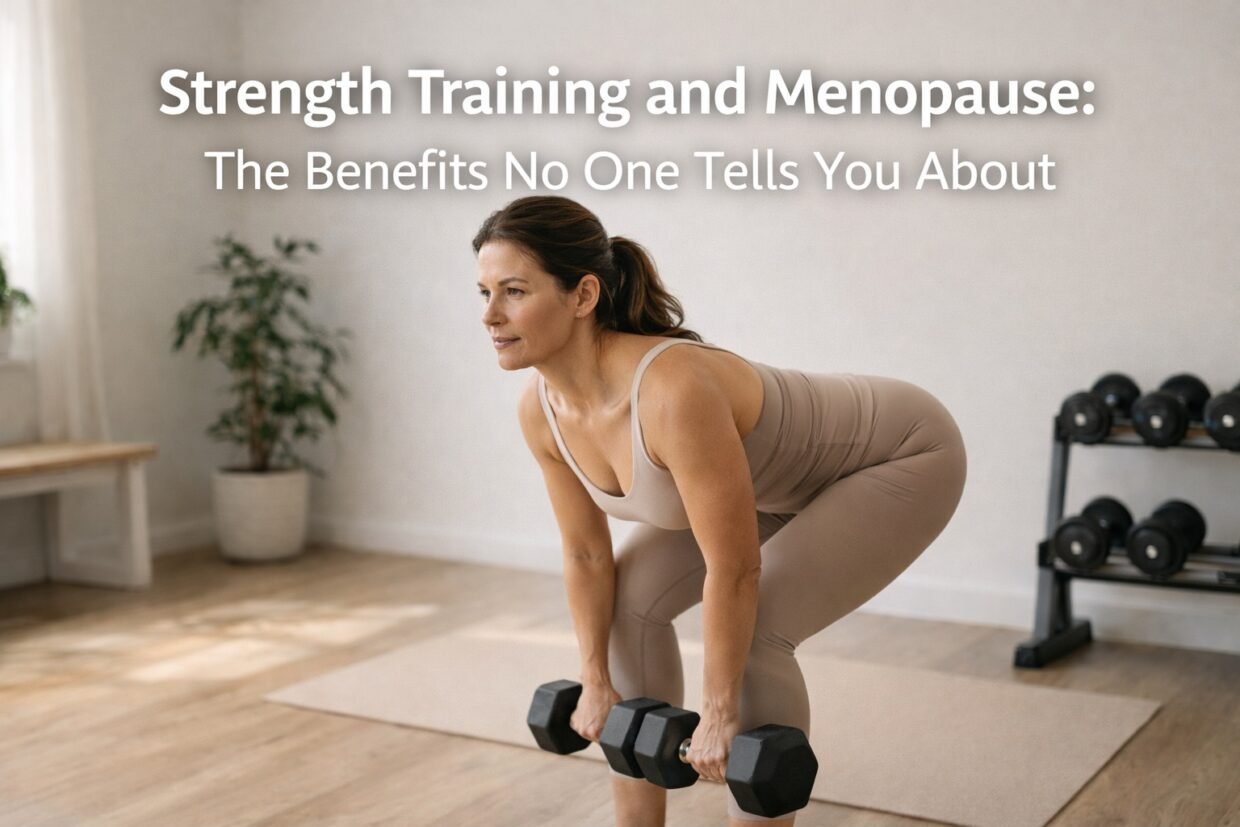
Most of what women hear about menopause focuses on what’s being lost — estrogen, bone density, muscle, sleep, metabolism. What gets far less airtime is how much of that can be reclaimed, protected, or reversed with one specific intervention: lifting weights. This is what the research actually shows.
About This Article
This article is informed by peer-reviewed research published in PMC, Frontiers in Reproductive Health, Scientific Reports, the Journal of the International Society of Sports Nutrition, and PubMed-indexed systematic reviews and meta-analyses through 2025. Where the evidence is strong, we say so. Where it’s preliminary or conflicting, we say that too. We cite the research in the body text so you can verify it yourself. This article does not replace the advice of your doctor or gynaecologist.
What Actually Happens to Your Body During Menopause
Understanding what’s happening physiologically makes the case for strength training far more compelling than any motivational framing. These are not vague feelings — they are documented, measurable changes with specific mechanisms.
Menopause is defined as 12 consecutive months without a menstrual period, typically occurring between ages 45 and 55. The transition leading up to it — perimenopause — often begins in the late 30s or early 40s and can last 7–10 years. During this time, estrogen and progesterone levels fluctuate unpredictably before declining sharply.
Estrogen is not just a reproductive hormone. It plays direct regulatory roles in bone metabolism (suppressing osteoclast activity, which breaks bone down), muscle protein synthesis, fat distribution, sleep architecture, mood regulation through serotonin and dopamine systems, insulin sensitivity, cardiovascular protection, and cognitive function. When estrogen declines, all of these systems are affected simultaneously. That’s why menopause feels like so many things happening at once — because it is.
Here’s what the research has established with strong evidence:
- Women lose 1–2% of bone mineral density per year in the first 5 years after menopause, and up to 10% in the first decade
- Visceral fat increases from approximately 5–8% to 10–15% of total body weight during the menopausal transition
- Muscle mass decreases by 10% in the arms and legs between early perimenopause and postmenopause
- Resting metabolic rate declines — not just because of hormones but significantly because of muscle loss
- Over 30% of women experience depressive episodes during the transition; over 50% report anxiety
- 75% of menopausal women experience hot flashes, which can persist for 4–10+ years
- 70–80% experience sleep disturbances from night sweats and hormonal disruption
This sounds daunting. It’s supposed to. Because the scale of what menopause affects is exactly why the intervention needs to be broad enough to address multiple systems simultaneously — and resistance training is the only non-pharmacological intervention with that scope.
A 2025 study in Research in Strength and Performance summarized it this way: resistance training “directly targets many of the adverse metabolic consequences of perimenopause” and is associated with long-term reductions in blood pressure, improvements in lipid profiles, increases in lean mass and resting metabolic rate, and improvements in insulin sensitivity — making it “a cornerstone in managing cardiometabolic health across the menopausal transition.”
Benefit 1: Bone Density — The Most Critical Protection You Have
This is where the evidence is strongest, and where the stakes are highest. Osteoporosis affects more women than men over 50 globally. In the United States alone, an estimated 8 million women have osteoporosis. The hip fracture that follows a fall in your 70s is not just a broken bone — it’s a life-altering event with a sobering 1-year mortality rate of 15–30% in older adults.
Bone isn’t static tissue. It is constantly remodeled — broken down by cells called osteoclasts and rebuilt by cells called osteoblasts. Estrogen suppresses osteoclast activity, which is why its decline during menopause tips the balance sharply toward breakdown over rebuilding. The result is accelerated bone mineral density loss at the hip, femoral neck, and lumbar spine — precisely the sites most vulnerable to fracture.
Strength training intervenes through a mechanism called mechanotransduction. When you place load on bone through weight-bearing exercise, the mechanical stress signals osteocytes — bone cells that act as mechanosensors — to trigger osteoblast activity. In plain terms: lifting weights tells your bones they need to be stronger, and your bones respond by becoming denser.
A 2025 systematic review and meta-analysis published in the Journal of Orthopaedic Surgery and Research covering studies through March 2025 confirmed that resistance training plays a positive role in increasing or maintaining bone mineral density in postmenopausal women, with high-intensity resistance training showing stronger effects on lumbar spine density than low or moderate intensity.
A separate 2025 scoping review published in Frontiers in Reproductive Health — covering literature from 2004 through 2024 — found that resistance training completed over at least 6 months significantly preserved bone mineral density in postmenopausal women. The word “preserved” is important: you are protecting what you have and slowing what would otherwise accelerate.
The landmark LIFTMOR trial, frequently cited in this field, found that a supervised high-intensity resistance and impact training program produced significant and safe gains in spine and hip bone density in postmenopausal women with osteopenia and osteoporosis — women who had already started losing bone. The program ran twice per week.
You don’t need to train at 85% of your 1-rep max from week one. The research is clear that moderate-to-high loads (65–80% of 1RM) performed 3 times per week produce consistent improvements in bone mineral density at the spine and hip. That translates to weights that feel genuinely challenging for 6–12 reps per set — exactly the framework in our 4-week beginner program.
Benefit 2: The Belly Fat Problem — And Why Strength Training Is the Answer
“Why am I gaining weight in my stomach when I haven’t changed anything?” is one of the most common questions women in perimenopause ask. The answer is frustrating but specific: declining estrogen directly alters fat distribution, shifting storage from the hips and thighs toward the abdomen. Visceral fat — the metabolically active fat that surrounds internal organs — increases from approximately 5–8% to 10–15% of total body weight during the menopausal transition.
Visceral fat isn’t just an aesthetic concern. It’s inflammatory. It produces pro-inflammatory cytokines that contribute to cardiovascular disease, insulin resistance, and systemic inflammation — all of which worsen during the menopausal transition anyway. Reducing visceral fat is therefore a health intervention, not a cosmetic one.
A 2023 systematic review and meta-analysis published in PMC examining the effects of exercise training on body composition in postmenopausal women found that resistance training produced the greatest benefits on muscle mass outcomes, while combined aerobic and resistance training produced the most comprehensive effects on fat mass, waist circumference, and visceral fat. Both had meaningful benefits, but resistance training was the more effective tool for preserving and building the lean tissue that drives metabolic rate.
Here’s the metabolic mechanism: muscle is metabolically active tissue. It burns calories at rest — somewhere between 6 and 10 calories per pound of muscle per day. Building and preserving muscle through strength training raises your resting metabolic rate, meaning your baseline calorie burn increases even when you’re sitting still. This is why women who strength train consistently through the menopausal transition don’t experience the same degree of unexplained weight creep as those who don’t.
The Bone Estrogen Strength Training (BEST) study — a 6-year longitudinal study of postmenopausal women — found that women who maintained higher frequency and volume of resistance training over those 6 years prevented weight gain and slowed fat deposition compared to those who trained less consistently. Six years of data, not six weeks.
Visceral fat as a proportion of body weight during menopause — up from 5–8% pre-menopause
Muscle mass lost in the arms and legs between early perimenopause and postmenopause
Average annual weight gain for postmenopausal women without intervention
Average increase in resting metabolic rate from 9 months of consistent resistance training
Benefit 3: Hot Flash Reduction — The Benefit Almost Nobody Mentions
This one surprises most women, including many who’ve been strength training for years without knowing about it.
Hot flashes — vasomotor symptoms — affect approximately 75% of menopausal women and can persist for 4–10 years or longer. They’re caused by the hypothalamus becoming hypersensitive to small temperature fluctuations as estrogen declines. The thermoregulatory center essentially misfires, triggering a cascade of vasodilation, sweating, and rapid heart rate in response to temperature changes that previously went unnoticed.
In 2019, a randomized controlled trial published in the journal Maturitas tested a 15-week resistance training program in postmenopausal women and found a statistically significant decrease in the frequency of moderate and severe hot flashes. The authors concluded that resistance training “could be an effective and safe treatment option to alleviate vasomotor symptoms.” That’s direct language from a peer-reviewed RCT.
The mechanism is not fully established, but the leading theory involves improved autonomic nervous system regulation. Resistance training — over time — improves the body’s ability to regulate cardiovascular and thermoregulatory responses, essentially recalibrating the sensitivity of the thermoregulatory center. It also reduces systemic inflammation markers that may contribute to vasomotor symptom severity.
A separate systematic review covering 12 trials of strength exercise in menopausal women confirmed that one study found strength training decreased both heart rate and the frequency of hot flashes, while another reported reductions in systolic blood pressure alongside metabolic improvements. The evidence isn’t as voluminous as it is for bone density, but what exists points consistently in the same direction.
Not all research on exercise and hot flashes has shown statistically significant effects. Some trials found no significant reduction. The evidence here is real but not as settled as the bone density and body composition data. If hot flash management is your primary concern, discuss all options with your doctor — including HRT, which has the strongest evidence for vasomotor symptom relief. Strength training is a meaningful complement, not necessarily a replacement.
Benefit 4: Mental Health, Mood, and the Brain Nobody Tells You About
The psychiatric dimension of menopause is significantly underreported and undertreated. Over 30% of women experience depressive episodes during the menopausal transition. Over 50% report anxiety. Mood swings, irritability, brain fog, difficulty concentrating, and poor sleep compound one another into something that looks like a mental health crisis but is, at its root, a neurochemical one — driven by estrogen’s declining influence on serotonin, dopamine, and GABA systems.
A 2025 paper in Research in Strength and Performance reviewed the mental health evidence and found that resistance training demonstrates “consistently positive effects on mood, cognitive function, and overall psychological well-being in pre-, peri- and postmenopausal females.” These benefits appear to be mediated by endorphin release, reduced systemic inflammation (which independently affects mood), improved sleep quality, and neuroplasticity-promoting effects.
Neuroplasticity is the part that tends to surprise people. Resistance training has been shown to promote brain-derived neurotrophic factor (BDNF) — a protein that supports the growth and maintenance of neurons, protects against cognitive decline, and is directly associated with improvements in memory and executive function. The brain needs physical challenge to stay sharp. Strength training provides that challenge in a way that walking and yoga alone typically don’t.
Emerging research on creatine supplementation — covered in our creatine safety guide — suggests an additional avenue for cognitive support through improved brain energy metabolism, particularly relevant during a period when the brain is already under hormonal stress.
There’s also the confidence factor, which doesn’t show up in meta-analyses but shows up in every real conversation with women who’ve been lifting for six months or more. Getting physically stronger when everything else feels like it’s getting harder is not a small thing. The psychological impact of proving to yourself that you can do hard things consistently — that you’re not declining, you’re building — is real and documented in quality-of-life measures across multiple trials.
Benefit 5: Better Sleep — The Compound Effect You Didn’t Expect
Sleep and menopause have a complicated relationship. Night sweats disrupt sleep architecture. Declining estrogen and progesterone independently affect sleep quality even without vasomotor symptoms. Poor sleep elevates cortisol the following day, which worsens hot flashes, increases appetite for high-calorie food, and impairs the muscle recovery that makes your training worthwhile. It’s a compounding negative loop.
Strength training interrupts that loop from multiple angles. The physical exertion of a resistance training session increases adenosine levels — the chemical signal for sleep pressure — which improves both sleep onset and the proportion of time spent in deep sleep. Deep sleep is where growth hormone is released, where muscle tissue is repaired, and where the emotional processing that stabilizes mood happens.
Research consistently links regular strength training to improved sleep duration and quality in postmenopausal women. The American College of Sports Medicine notes that sleep quality improvement is one of the well-documented outcomes of regular resistance training in this population.
The catch — and it’s worth knowing — is timing. Vigorous strength training within 2–3 hours of bedtime can temporarily elevate core body temperature and heart rate in a way that delays sleep onset for some women. If this applies to you, morning or early afternoon training sessions produce better sleep outcomes than late evening sessions.
Benefit 6: Insulin Sensitivity — The Metabolic Protection Most Women Don’t Know They Need
Menopause significantly increases the risk of type 2 diabetes. The mechanism is direct: estrogen plays a role in insulin signaling, and its decline during menopause reduces insulin sensitivity — meaning cells don’t respond to insulin as efficiently, leading to higher blood glucose levels, greater fat storage, and increased diabetes risk.
Skeletal muscle is the primary site of glucose uptake after a meal. When you eat carbohydrates, the resulting blood glucose is absorbed primarily by muscle cells — but only to the extent that those muscle cells are insulin sensitive. More muscle mass and higher muscle quality means better glucose disposal, lower post-meal blood glucose spikes, and reduced insulin resistance.
A 2025 paper in Research in Strength and Performance confirmed that resistance training promotes increases in lean mass and improves insulin sensitivity specifically during the period of estrogen withdrawal — precisely when insulin resistance is rising hormonally. This is not a small benefit for a population at elevated metabolic risk.
Combined aerobic and resistance training produces the most comprehensive improvements in glycemic control — but resistance training alone has meaningful independent effects. Studies show reductions in fasting blood glucose and HbA1c levels in postmenopausal women who strength train consistently.
Benefit 7: Long-Term Functional Independence — The Biggest Benefit Nobody Talks About
Everything above is measurable in a clinical trial. This one is harder to put in a table but may matter most.
The cumulative effect of declining muscle mass, reduced bone density, worsening balance, and increasing fall risk that begins during the menopausal transition creates a trajectory toward frailty and dependence that, for too many women, plays out in their 70s and 80s. The hip fracture. The inability to get off the floor unassisted. The loss of the physical confidence to live independently.
This trajectory is not inevitable. It is not simply aging. It is the consequence of specific physiological losses that strength training directly counteracts — maintained across decades, not just weeks.
The women I’ve trained who started in their early 40s and are now in their late 50s or early 60s are not the women their peers predicted they’d be. They’re stronger now than they were at 35. Their bone density is stable or improving while their non-training peers are declining. They fall less because their balance and proprioception are better. They carry groceries, get up off the floor, take stairs, and move through the world with a confidence that doesn’t come from a pill.
That’s not inspirational rhetoric. That’s the compounded clinical outcome of 15–20 years of consistent resistance training, demonstrated in longitudinal studies and lived by real women who made the decision to start.
How to Actually Train During Menopause
The American College of Sports Medicine recommends at least 2–3 days per week of strength training for major muscle groups in postmenopausal women. The evidence suggests moderate-to-high intensity (60–80% of 1-rep max) with 8–12 repetitions per set for the best combination of muscle and bone outcomes. Progressive overload — gradually increasing the challenge over time — is non-negotiable for continued adaptation.
What the research supports specifically
Compound movements — squats, deadlifts, rows, presses, lunges — are the exercises with the strongest evidence for both muscle and bone outcomes. They load multiple joints and muscle groups simultaneously, creating the mechanical stress that bones respond to and the hormonal environment (growth hormone, IGF-1) that muscle growth requires.
You do not need to train at maximum intensity from the start. A well-structured beginner program with progressive overload produces bone and muscle adaptations within 6–12 weeks of consistent training. See our complete 4-week beginner program for a done-for-you starting point.
Adjustments specific to the menopausal transition
Recovery takes longer. The hormonal environment that accelerated recovery in your 30s — including growth hormone release and estrogen’s anti-inflammatory effects — is diminished. This means 48–72 hours between sessions targeting the same muscle groups is more important, not less, than it was earlier. Three sessions per week with a full-body structure is typically more productive than 5 sessions with a split routine for women in perimenopause or early postmenopause.
Protein requirements increase. The anabolic resistance that develops with age and hormonal change means you need more dietary protein to produce the same muscle protein synthesis response. Research supports 1.6–2.0g per kilogram of bodyweight daily for active women over 40. If food alone isn’t covering that, a quality protein supplement is a practical solution — see our protein powder review for tested options.
Joint sensitivity is real — work with it. Reduced estrogen affects cartilage and connective tissue. Exercise selection should account for this: reverse lunges over forward lunges, floor press before bench press for those with shoulder sensitivity, Romanian deadlifts before conventional for those with lower back concerns. The goal is to find the variations that produce the mechanical stimulus without aggravating joints.
Consistency beats intensity. The bone density and metabolic benefits of resistance training are longitudinal — they accumulate over months and years, not sessions. A consistent moderate-intensity program maintained for 12 months produces significantly better outcomes than a high-intensity program abandoned after 8 weeks from overtraining or burnout.
What About HRT? Can You Do Both?
Yes — and the research suggests the combination is more effective than either alone.
Hormone replacement therapy (HRT/MHT) works by partially restoring estrogen levels, which directly reduces vasomotor symptoms, slows bone resorption, and helps maintain the hormonal environment that supports muscle protein synthesis. Strength training provides the mechanical and metabolic stimulus that estrogen alone can’t deliver — physical load on bone, progressive overload for muscle growth, metabolic improvements through lean mass gain.
A 2025 scoping review published in Frontiers in Reproductive Health covering evidence from 2004–2024 found that the combination of MHT and resistance training produced more favorable bone density outcomes than either intervention alone. The two mechanisms are complementary: MHT reduces bone resorption while resistance training stimulates bone formation.
The decision about HRT is a clinical one that belongs between you and your doctor. It is not straightforward — individual risk factors, medical history, symptom severity, and personal preferences all matter. HRT is not appropriate for every woman. But if you are on HRT and wondering whether you still need to exercise: yes, absolutely. The hormonal protection HRT provides does not replace the mechanical stimulus that bones and muscles require. Both work better together than either does alone.
The information in this article is evidence-based and educational — it is not medical advice. Menopause management is individual. Symptoms, severity, cardiovascular risk, bone health status, family history of breast cancer, and many other factors shape what interventions are appropriate for each woman. Please work with your GP, gynaecologist, or a menopause specialist alongside any fitness program you begin.
Frequently Asked Questions
Yes — with meaningful evidence across multiple symptoms. The strongest evidence supports benefits for bone density preservation, improved body composition, visceral fat reduction, better insulin sensitivity, improved mood and cognitive function, and better sleep quality. Evidence for hot flash reduction is real but less consistent — some trials show significant reduction, others show minimal effect. Strength training is not a replacement for HRT for women with severe vasomotor symptoms, but it is a powerful non-pharmacological intervention that addresses many of the physiological changes of menopause simultaneously.
The American College of Sports Medicine recommends at least 2–3 sessions per week targeting major muscle groups, with at least 48 hours between sessions for the same muscle groups. After 40, recovery is slower than it was in your 30s — quality and consistency matter more than frequency. Three well-executed full-body sessions per week is typically more productive than five sessions that push you into overtraining or injury. Start with our 4-week beginner program if you’re new to lifting.
No — and the research says this clearly. Multiple studies in postmenopausal women, including women in their 60s and 70s, show meaningful gains in muscle strength, muscle mass, bone density, and functional capacity from resistance training started at any point after menopause. The mechanisms don’t turn off. The rate of adaptation may be slightly slower than in premenopausal women, but the direction is the same: consistent progressive resistance training builds muscle and protects bone at any age.
Exercise itself can temporarily trigger a hot flash in some women due to the rise in core body temperature during activity. This is not a reason to avoid exercise — it is typically transient and subsides post-workout. The long-term evidence points toward strength training reducing hot flash frequency and severity over weeks of consistent training. Training in a cool environment, staying well hydrated, and avoiding the hottest part of the day for outdoor workouts can help manage exercise-induced vasomotor responses.
Yes — indirectly but significantly. The visceral fat accumulation that occurs during the menopausal transition is driven partly by hormonal changes in fat distribution and partly by declining muscle mass lowering resting metabolic rate. Resistance training addresses both: it preserves and builds the lean tissue that raises metabolic rate, and evidence from multiple meta-analyses shows it reduces waist circumference and visceral fat in postmenopausal women over medium-to-long training durations. Combined aerobic and resistance training produces the most comprehensive body composition outcomes.
Compound, weight-bearing exercises that load the spine and hips have the strongest evidence for bone density outcomes: squats (goblet squats for beginners), Romanian deadlifts, hip hinges, and overhead pressing movements. These exercises create the mechanical load through bone that stimulates osteoblast activity and bone remodeling. The research specifically supports moderate-to-high intensity loading (60–80% of 1RM) at the spine and hip sites most vulnerable to osteoporotic fracture. Balance training alongside strength work also reduces fall risk, which is the proximate cause of most osteoporotic fractures.
The Program Built for This Exact Stage of Life
Our complete beginner’s guide to strength training was written specifically for women over 40 — covering how your body works at this stage, what exercises matter most, and how to train in a way that compounds over years, not just weeks.
Medical disclaimer: This article is for informational and educational purposes only and does not constitute medical advice, diagnosis, or treatment. The menopause transition is a medical event with significant individual variation — what is appropriate for one woman may not be appropriate for another depending on personal health history, existing conditions, and medications. Always consult your GP, gynaecologist, or a menopause specialist before making significant changes to your exercise routine, particularly if you have been diagnosed with osteoporosis, cardiovascular disease, or are managing other health conditions.
Sources used in this article include: Journal of Orthopaedic Surgery and Research (2025), Frontiers in Reproductive Health (2025), Research in Strength and Performance (2025), Scientific Reports (2025), PMC systematic reviews (2023–2025), PubMed RCTs including the LIFTMOR trial and Maturitas (2019) resistance training and hot flash RCT. Specific citations are embedded in the text.