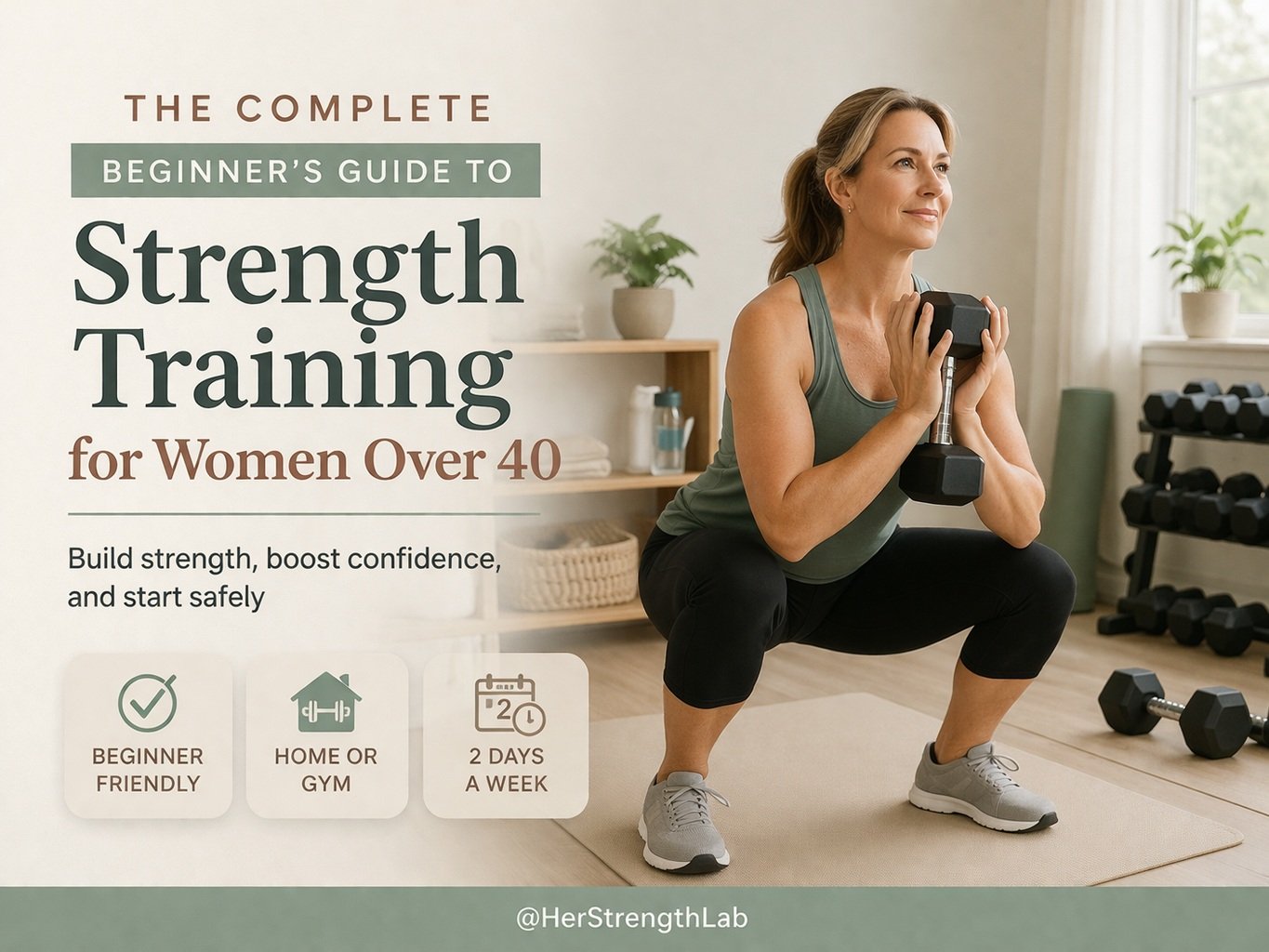


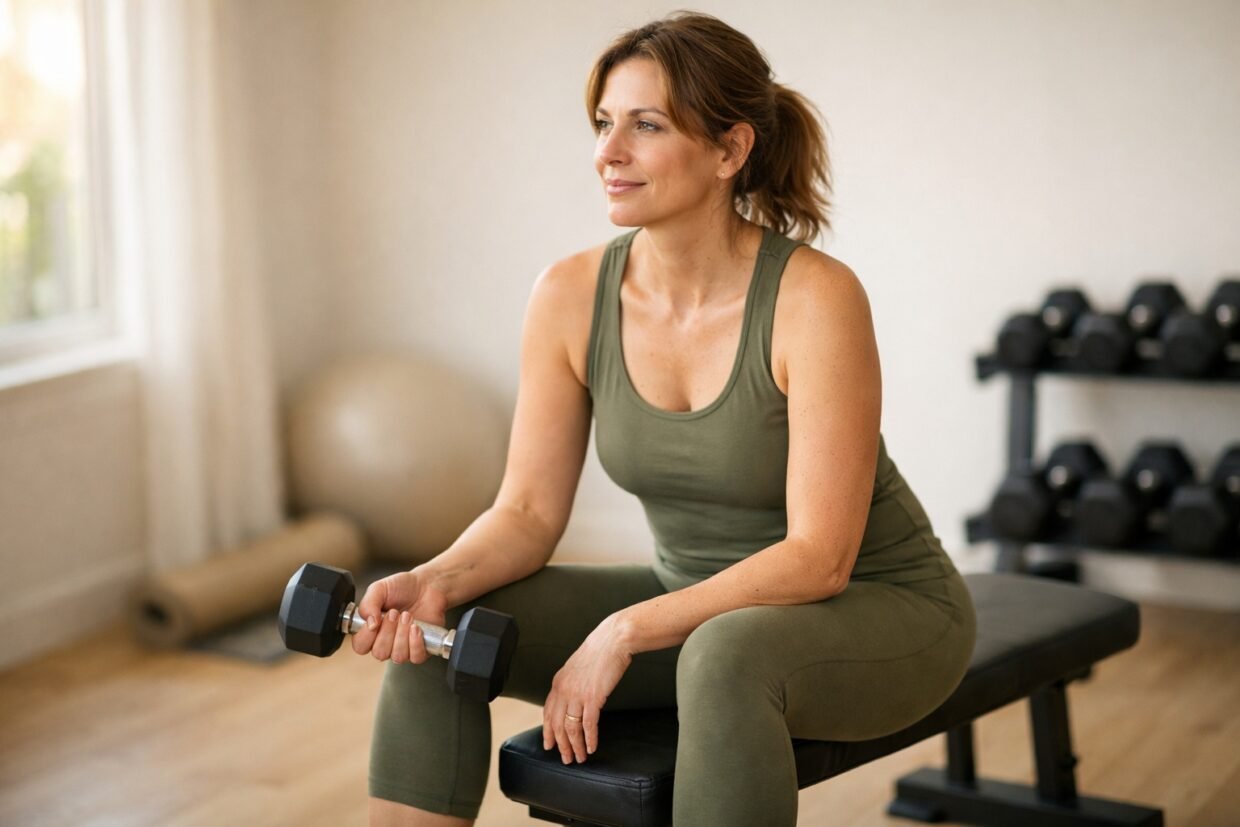
So you’ve decided to start. Or you’re thinking about it seriously for the first time. Either way — this guide covers everything: what actually changes in your body after 40, how to start safely, what to lift, how often, and what to expect when you do.
The Honest Truth About Starting at 40
Let me say this clearly before anything else: 40 is not too late. I’ve worked with women who picked up their first dumbbell at 47, at 52, at 61. Every single one of them built real muscle, got genuinely stronger, and — this is the part that surprises people most — said they wished they’d started sooner.
The research backs this up completely. Your muscles don’t know how old you are. They respond to load. Apply consistent, progressive resistance and your body adapts — at 40, at 50, at 60. The mechanism doesn’t turn off. What changes is how you need to approach training, how much recovery matters, and how patient you need to be with the process.
Here’s what I tell every woman I work with who’s just starting: your 20-year-old self could train dumb and still get results. You can’t afford to train dumb anymore — not because you’re old, but because you’re smart enough to know better. Training smarter after 40 isn’t a compromise. It’s actually how training should have been done all along.
Women who do strength training 2–3 times per week are significantly more likely to live longer and have a lower risk of dying from heart disease compared to women who don’t — that’s from a 2024 study covered in our Complete Beginner’s Guide. Two to three sessions a week. That’s it. That’s the threshold.
What Changes in Your Body After 40 — And Why It Matters for Training
Understanding what’s actually happening inside your body after 40 isn’t about scaring yourself. It’s about training with context instead of against it.
Estrogen starts declining
This begins in your mid-to-late 30s and accelerates through perimenopause. Estrogen plays a direct role in how efficiently your body builds and maintains muscle, manages inflammation, and recovers from training. Lower estrogen means slower muscle protein synthesis, increased sensitivity to training stress, and longer recovery time between sessions. It doesn’t mean you can’t build muscle. It means you need to be more deliberate about recovery.
Muscle mass starts decreasing
The medical term is sarcopenia — the gradual, age-related loss of muscle tissue. It starts around 30 and accelerates if you’re not actively fighting it with resistance training. You lose approximately 3–8% of your muscle mass per decade. By 40, if you haven’t been lifting, you’ve likely already lost a meaningful amount of the muscle you had in your 20s. The good news: this is highly reversible. Resistance training is the single most effective intervention for sarcopenia at any age.
Bone density begins declining
Bone mass peaks in your late 20s. After 40 — and especially after menopause — bone loss accelerates. An estimated 8 million women in the United States have osteoporosis. Strength training is one of the most effective tools we have to slow and reverse this decline, because lifting weights stresses the bone, which responds by becoming denser. Weight-bearing exercise is the stimulus your skeleton needs.
Metabolism slows
Partially because of hormonal changes, and significantly because of muscle loss. Muscle is metabolically active tissue — it burns calories even at rest. Less muscle means a slower resting metabolism. Nine months of resistance training has been shown to increase resting metabolic rate by an average of 5%, roughly 158 additional calories per day. That compounds meaningfully over years of consistent training.
Joints become more sensitive
Reduced estrogen affects cartilage and connective tissue. Joints that felt fine at 30 may feel stiffer, crankier, or more prone to irritation at 42. This doesn’t mean avoiding load — it means being more thoughtful about which exercises you choose, how you warm up, and how you manage volume. Joint-friendly loading is a feature of smart training, not a limitation.
Every single change listed above is either slowed, stopped, or reversed by consistent strength training. That’s not an exaggeration — it’s what the research shows. You’re not fighting your body. You’re giving it exactly what it’s asking for.
Before You Lift a Single Weight — Do These 3 Things
1. Get medical clearance if you need it
If you’re generally healthy, have no diagnosed conditions, and haven’t been told by a doctor to avoid exercise — you don’t need to wait for a doctor’s appointment to start. Go. Start with light loads and build gradually.
If you have osteoporosis, osteopenia, a history of cardiovascular disease, joint replacements, or you’re managing a chronic condition — talk to your doctor first. Not to get permission to exercise (the evidence for exercise is overwhelming in virtually every health condition), but to understand any specific movement restrictions. Most doctors will actively encourage you to start strength training.
2. Set one specific, concrete goal
“Get fit” is not a goal. “Be able to do 3 sets of 10 goblet squats with a 25 lb dumbbell by week 12” is a goal. “Lose weight” is a wish. “Hit 100g of protein per day and train 3 times per week for 8 weeks straight” is a goal.
Goals that are specific give you something to measure. Goals you can measure keep you from quitting when progress feels invisible — which it does, for everyone, somewhere around weeks 3 and 4.
3. Decide where you’re training
Home or gym — both work. The best option is the one you’ll actually use consistently.
Home training: Lower barrier to entry, no commute, no self-consciousness. Requires some upfront equipment investment. A pair of adjustable dumbbells and a resistance band set covers everything you need for at least 12 months of beginner training. See our tested picks in Best Adjustable Dumbbells for Women Over 40 and Best Resistance Bands for Women Over 40.
Gym training: Access to more equipment and heavier loads. Better for women who want the social motivation of being around other people training. If gym intimidation is a factor — it’s real and it’s common — we have a full guide on that coming soon.
What to Actually Lift: The 5 Movements That Matter Most
Before you look at any specific exercise, understand this principle: train movement patterns, not muscles. Your body doesn’t work in isolation — it works in coordinated movement patterns. Training those patterns builds the kind of strength that transfers to real life.
There are five patterns that cover the vast majority of your body’s musculature and the movements that matter most for women over 40:
| Pattern | Best Beginner Exercise | Main Muscles | Why It Matters at 40+ |
|---|---|---|---|
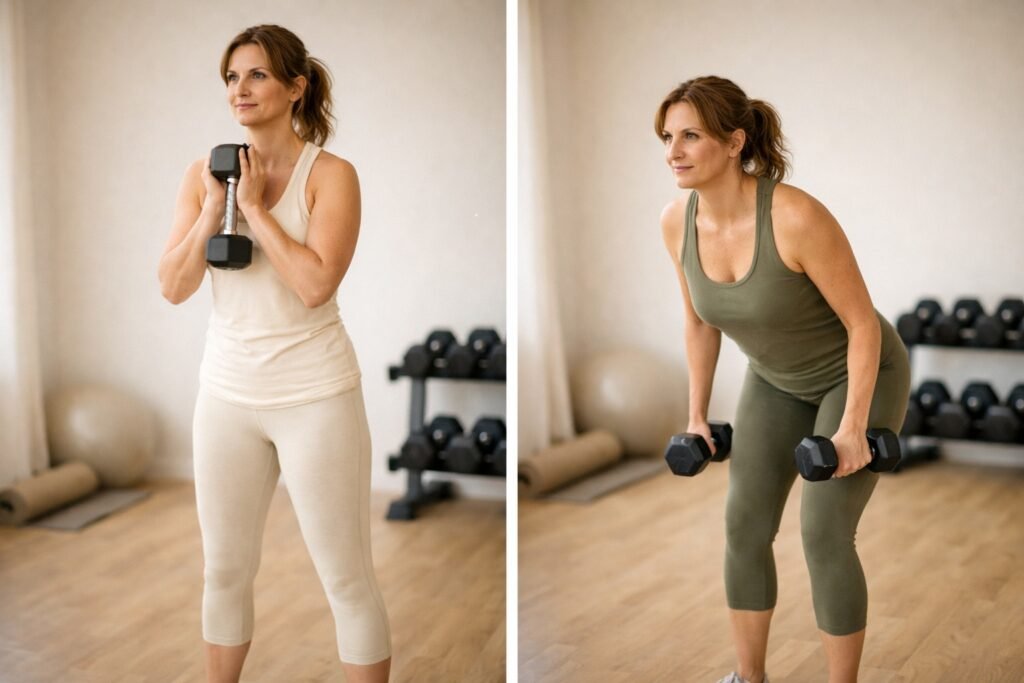
| Squat | Goblet squat (dumbbell at chest) | Quads, glutes, core | Protects hips and spine; mirrors getting up from chairs, stairs, floor |
| Hip Hinge | Romanian deadlift (dumbbells) | Hamstrings, glutes, lower back | Builds posterior chain strength; protects lower back from injury |
| Push | Dumbbell floor press or incline press | Chest, shoulders, triceps | Upper body pressing strength; helps posture and overhead function |
| Pull | Single-arm dumbbell row | Back, biceps, rear delts | Counteracts rounded-shoulder posture; builds back strength |
| Carry / Brace | Farmer’s carry or dead bug | Core, grip, full body stability | Functional core strength; directly transfers to daily life |
That’s your entire beginner program. Five patterns. You don’t need 20 exercises. You don’t need to work each muscle group separately on different days. You don’t need anything fancy. Master these five, add load progressively, and you will get stronger, build muscle, and improve your body composition. Everything else is variation and detail that comes later.
A note on exercise order
Do your heaviest compound movements first, when you’re freshest. Squat and hinge before you press and row. Save carries and core work for the end. This isn’t arbitrary — it’s about prioritizing the movements that require the most coordination and strength output when your neuromuscular system is at peak readiness.
How Often, How Long, How Heavy
Frequency: 2–3 times per week
This is not a beginner compromise — this is the scientifically supported optimal frequency for beginners. The American College of Sports Medicine recommends 2–3 strength sessions per week for women starting out. Your muscles need 48–72 hours to recover and rebuild after training. More sessions before that window closes doesn’t produce more results. It produces more fatigue.
Start with 2 sessions per week if you’ve never trained before. Add a third session once the first two feel manageable — typically around week 4 or 5.
Duration: 30–45 minutes per session
A well-structured 40-minute session covers everything you need. You’re not trying to set marathon records. You’re trying to apply a specific training stimulus, recover from it, and come back stronger. Long workouts don’t mean better results — they mean more recovery demanded.
How heavy: heavier than you think, lighter than your ego wants
This is the most common beginner mistake in both directions. Many women start too light — comfortable weights that never actually challenge the muscle — and then wonder why nothing changes. Some women start too heavy, form breaks down, and something gets hurt.
The right weight for any exercise is one where: the first 6–8 reps feel manageable, reps 9–11 feel genuinely hard, and rep 12 is the last one you could do with clean form. If you can do 15+ reps easily, go heavier. If your form collapses before rep 10, go lighter.
Before every set, pick a weight where you think your last 2 reps will be hard — not impossible, not comfortable. Genuinely challenging. That feeling of working hard through those last 2 reps is where most of the adaptation happens. Comfortable reps maintain. Hard reps build.
Sets and reps: start simple
For your first 4 weeks: 2–3 sets of 10–12 reps per exercise. Rest 60–90 seconds between sets. That’s your entire framework. Write it down, execute it consistently, and resist the urge to complicate it. Complexity comes later. Consistency comes first.
What Your First Session Should Look Like
Here’s an exact beginner session — your Session A. You’ll alternate this with Session B across your training week. Both sessions are full-body.
March in place 1 min · Arm circles (forward + back) 30 sec each · Hip circles 30 sec each · Bodyweight squat x10 slow · Cat-cow on hands and knees x10 · Band pull-apart x15 (if you have a band)
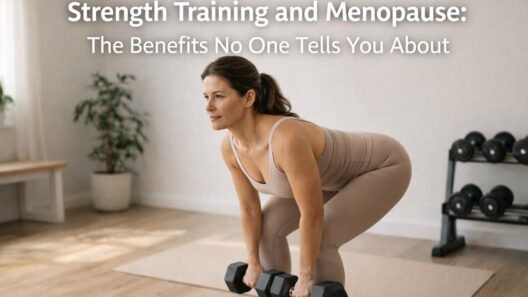
Hold one dumbbell vertically at your chest. Feet shoulder-width, toes slightly out. Sit down and back — chest up, knees track over toes. Come back up by pressing through your heels. Start with 8–15 lbs.
One knee and hand on bench or chair. Other foot on floor. Pull the dumbbell up toward your hip — elbow drives back, not out. Lower with control. Start with 10–15 lbs.
Lie on your back, knees bent, dumbbells at chest. Press up until arms are straight. Lower with 2–3 second count. Stop just before elbows touch floor. Start with 8–12 lbs per hand.
Stand holding dumbbells in front of thighs. Hinge at hips — push them back, not down. Lower dumbbells along your legs until you feel a pull in hamstrings (roughly mid-shin). Drive hips forward to stand. Start with 10–20 lbs.
Hold dumbbells at your sides, stand tall, shoulders back. Walk slowly and controlled. Feel your core bracing naturally. This is harder than it looks. Start with 15–20 lbs per hand.
Hip flexor stretch (kneeling) 30 sec each · Hamstring stretch seated 30 sec each · Chest opener (clasp hands behind back) 30 sec · Child’s pose 60 sec
Total time including warm-up and cool-down: approximately 40 minutes. Rest 60–90 seconds between each set. Don’t rush. The rest is part of the training.
The One Principle That Makes Everything Work
Progressive overload. Write it down. Tattoo it somewhere if you have to.
It means this: to keep getting stronger, your training must gradually become harder over time. Your body adapts to whatever stress you apply to it. Apply the same stress week after week and adaptation stops. Apply progressively more stress — slightly more weight, one more rep, a slower tempo — and adaptation continues.
This is the single concept that separates women who make consistent progress from women who plateau at month two and give up. Without progressive overload, you’re just maintaining. With it, you’re building.
How to actually apply progressive overload as a beginner
The simplest method: when you can complete all your sets and reps with clean form and the last 2 reps still feel challenging, add weight next session.
How much to add? Small increments only. 2.5 lbs per dumbbell for upper body exercises. 5 lbs per dumbbell for lower body exercises. These feel insignificant. They are not. A 2.5 lb increase per week on a pressing exercise compounds to 130 lbs heavier over a year. Nobody starts a beginner program pressing 130 lbs. But the increment is the mechanism.
Write down the exercise, weight used, sets completed, and reps completed. A notes app on your phone works perfectly. This is not optional — it’s the only way to know when to progress. You cannot track progress you haven’t measured. And seeing your numbers go up week after week is one of the most motivating things that happens in strength training.
5 Mistakes Women Make When Starting Out After 40
Mistake 1: Lifting weights that are too light
This is the most common mistake I see. Women pick up 5-pound dumbbells, do 3 sets of 15, and wonder why nothing changes after 6 weeks. Light weights at high reps improve muscular endurance. They do not build meaningful muscle or strength. To build muscle, you need to apply enough load that the muscle is actually challenged. Start lighter than you need to for form learning, then increase deliberately.
Mistake 2: Training every day
More is not better. Adaptation happens during rest, not during training. After 40, your recovery capacity is more limited than it was at 25. Strength training three times per week, with rest days between sessions, is optimal. Adding more sessions before recovery is complete produces diminishing returns and increases injury risk.
Mistake 3: Skipping the warm-up
Your 20-year-old self could skip a warm-up and get away with it. You cannot. Cold muscles, stiff joints, and a nervous system that isn’t activated yet are a combination that produces poor movement quality and increases injury risk. Five to eight minutes of dynamic warm-up before every session is not optional after 40. It’s how you protect the training that matters.
Mistake 4: Chasing soreness as the goal
Being very sore after every workout doesn’t mean you trained well. It means you trained unfamiliar movements or unusually high volume. Some soreness in week one and two is expected and normal. Consistent extreme soreness is a sign you’re doing too much. You want to leave sessions feeling worked but not broken. The goal is training you can repeat 48 hours later — not training that leaves you hobbling for three days.
Mistake 5: Waiting until conditions are perfect
Waiting until you have a gym membership. Waiting until after the holidays. Waiting until you lose some weight first (you won’t, without the training). Every week you wait is a week of muscle you didn’t build, bone density you didn’t protect, metabolism you didn’t stimulate. The perfect time to start was six months ago. The second-best time is today. An imperfect session with three exercises and light weights beats a perfect session that never happened.
Recovery After 40 — Why It’s Not Negotiable
Here’s a truth that took me years to fully accept as a trainer: the session is the stimulus. Recovery is where the result happens. You don’t get stronger during the workout. You get stronger in the 48–72 hours after it, provided you give your body what it needs to adapt.
After 40, recovery takes longer. Not dramatically — but meaningfully. What recovered in 36 hours at 28 may now need 48–60 hours. This is why training frequency needs to be thoughtful, not just maximal.
The three recovery inputs that matter most
Sleep. Growth hormone — the hormone most responsible for muscle repair after training — is released primarily during deep sleep. Chronic sleep deprivation doesn’t just make you tired. It directly undermines your body’s ability to adapt to training. Treat 7–9 hours of sleep as part of your training program, not separate from it.
Protein. Your muscles need the building blocks to repair and rebuild. After 40, research suggests targeting 1.6–2.0g of protein per kilogram of bodyweight daily — significantly more than the general health guideline. Distribute it across meals rather than loading it all at dinner. If hitting your protein targets is challenging, see our guide on Best Protein Powders for Women Over 40.
Rest days. Active rest (walking, gentle yoga, swimming at easy effort) is better than complete inactivity on off days — it promotes blood flow to recovering muscles without adding training stress. But rest days are rest days. Don’t fill them with HIIT classes because you feel like you should be doing something.
What to Realistically Expect in Months 1, 2, and 3
Social media has done real damage to expectations around strength training results. The before-and-after photos you see are compressed, curated, and often not representative of what consistent training actually produces over realistic timelines. Here’s what actually happens:
Month 1: Neural adaptation and soreness
In your first four weeks, most of the strength gains you experience have nothing to do with muscle growth. Your nervous system is learning to recruit muscle fibers more efficiently. You’ll get noticeably stronger without looking any different. This is not failure — it’s your nervous system getting out of the way so the muscles can do their job.
Expect soreness in week 1 and 2 — particularly in muscles you’ve never deliberately trained. It peaks around 24–48 hours after a session (called DOMS — delayed onset muscle soreness). It reduces significantly by week 3 as your body adapts to the training pattern.
Month 2: The first real changes
By week 6–8, you’ll start to notice things that aren’t visible in the mirror: energy levels improving. Stairs feeling easier. Carrying groceries without effort. Better posture. Clothes fitting slightly differently. Sleep improving. These functional changes often arrive before visible physical changes — and they’re real, meaningful progress.
Around this time, the habit starts to solidify. You stop dreading sessions and start protecting them. This is the inflection point that separates women who continue from women who stop. Push through weeks 3–5 — they’re often the mentally hardest stretch.
Month 3: Visible changes and genuine momentum
By week 10–12, body composition changes become visible. Muscle definition — particularly in arms, shoulders, and thighs — starts to appear. The scale may not move dramatically (muscle is denser than fat; you may gain a pound while losing two inches), but the mirror and how clothes fit will tell a different story.
More importantly, by month 3, you’ve built a habit. You’ve learned your body’s signals. You know when you’re genuinely fatigued versus just not in the mood. You’ve started progressing weights. And you’re starting to genuinely love it — not because someone told you to, but because you can feel what it’s doing.
Weeks until energy and sleep improvements are noticeable
Weeks until functional strength changes are clearly felt
Weeks until visible body composition changes appear
Months until the transformation worth photographing happens
Frequently Asked Questions
Yes — and not just safe, it’s one of the best things you can do for your health. Start with lighter weights and focus on movement quality first. If you have no diagnosed conditions and haven’t been told to avoid exercise, you can begin today. If you have specific health concerns, a quick conversation with your doctor will give you appropriate guidelines — most will actively support you starting strength training.
No. Women don’t produce enough testosterone to build large, bulky muscle without years of specific, deliberate effort and often hormonal assistance. Regular strength training for women over 40 produces a leaner, more defined physique — not a bodybuilder’s physique. The women you might be imagining train very differently from what’s described in this guide. The fear of bulking up is the single most persistent myth in women’s fitness, and it keeps too many women from training in a way that would genuinely transform their health.
Often yes — with modifications. Strength training is actually one of the best interventions for knee health because it strengthens the muscles that support and stabilize the joint. The key is exercise selection. Goblet squats with a controlled range of motion are typically gentler than deep barbell back squats. Romanian deadlifts are usually knee-friendly. Resistance band exercises and floor-based movements reduce compressive joint forces. If you have diagnosed joint conditions, work with a physical therapist to identify appropriate modifications — most PT protocols actively incorporate resistance training.
Functional improvements — more energy, better sleep, easier daily movements — typically appear in 2–3 weeks. Visible changes in muscle tone and body composition usually begin at 8–12 weeks of consistent training. The timeline is longer than social media suggests, but the results are more durable. Most women who lift consistently for 6 months describe it as one of the most transformative things they’ve done for their health and confidence.
Not necessarily. A trainer is valuable for learning movement quality and staying accountable — especially in the first 4–6 weeks. But with good resources (like this guide and our Complete Beginner’s Guide), you can absolutely start safely on your own. Film yourself doing exercises and compare to technique videos. Start lighter than you think you need to. Progress slowly. And consider a few sessions with a trainer if you feel uncertain about your form on any key movement.
If you’re doing both in the same session, do strength training first. Cardio depletes your energy reserves and impairs the quality of strength work that follows. Strength training on a fresh nervous system produces better results and better technique. Do your cardio after, or on separate days. Better yet — for women over 40 specifically, consider treating cardio as walking and prioritizing strength work as your dedicated training sessions. Both matter, but strength training addresses more of the physiological concerns after 40 than cardio alone.
The minimum viable home setup: a set of adjustable dumbbells (or 2–3 fixed pairs in light, medium, and moderate weight) and a resistance band set. That covers every exercise in this guide and enough variety for 12–18 months of consistent training. See our tested equipment guides: Best Adjustable Dumbbells and Best Resistance Bands.
Get the Complete Beginner’s Guide
The science behind strength training after 40, a full 12-week program structure, recovery protocols, and everything else you need to go from zero to consistent — all in one place.
Medical disclaimer: This article is for informational purposes only and does not constitute medical advice. Consult your healthcare provider before beginning a new exercise program, particularly if you have existing health conditions, joint issues, osteoporosis, or cardiovascular concerns. The exercises and recommendations in this guide are general in nature and may not be appropriate for all individuals.