


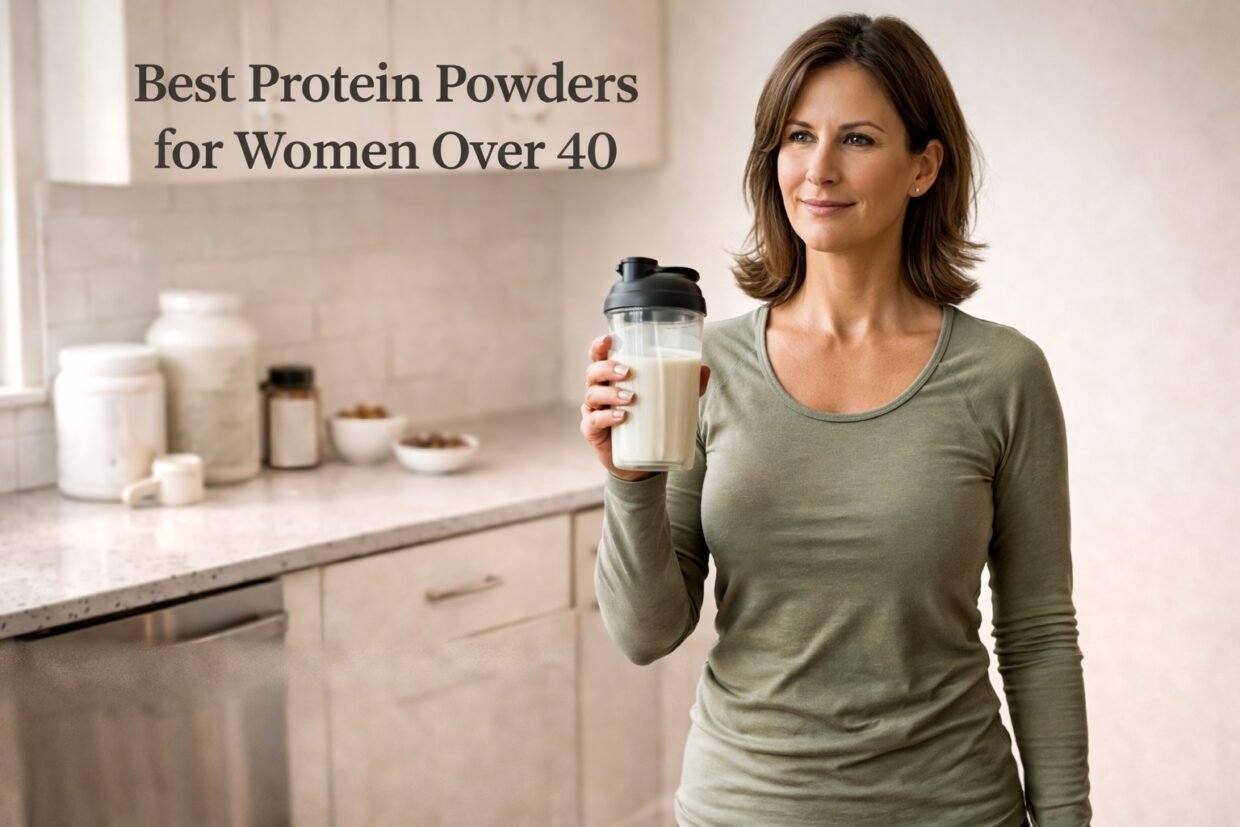
Best Protein Powders for Women Over 40: Protein after 40 isn’t optional — it’s the foundation of everything from muscle preservation to bone density to metabolism. We reviewed five of the most popular options on Amazon, broke down what’s actually in each one, and told you the honest truth about who should buy what.
| # | Product | Type | Protein/Serving | Best For | Rating |
|---|---|---|---|---|---|
| 1 | Vital Proteins Collagen Peptides | Collagen | 18g collagen protein | Joints, Skin, Bones | ★★★★½ |
| 2 | ON Gold Standard Whey | Whey blend | 24g protein | Best Overall Whey | ★★★★½ |
| 3 | Premier Protein Whey Powder | Whey isolate/concentrate | 30g protein | Highest Protein / Budget | ★★★★ |
| 4 | Orgain Organic + Superfoods | Plant-based | 21g protein | Best Dairy-Free Option | ★★★★ |
| 5 | Ancient Nutrition Multi Collagen | Multi-collagen + probiotics | 9g per scoop / 18g per 2 scoops | Best for Gut + Joint Health | ★★★★ |
Why Protein Matters More After 40 — Not Less
Here’s what most people don’t realize: after 40, your body becomes less efficient at turning dietary protein into muscle tissue. The scientific term is “anabolic resistance” — you need more protein to trigger the same muscle-building response that lower amounts used to produce in your 20s.
Combined with the natural muscle loss that begins in your 30s (3–8% per decade without resistance training), this creates a situation where inadequate protein intake accelerates exactly the decline you’re trying to prevent. The research is clear: women over 40 who strength train need significantly more protein than the general health recommendation of 0.8g per kg of bodyweight. Current evidence points to 1.6–2.0g per kg of bodyweight daily — roughly double the standard guideline.
Food first, always. Eggs, chicken, fish, Greek yogurt, cottage cheese, legumes — these are your foundation. Protein powder is a supplement to fill the gaps when whole food isn’t convenient or sufficient. That’s it. But those gaps are real, and a quality powder makes hitting your daily target significantly more manageable.
Adequate protein isn’t just about muscle. A 2022 meta-analysis found that higher protein intake is associated with greater bone mineral density and a lower risk of osteoporosis in older women. Combined with resistance training and calcium/vitamin D, protein is one of three critical inputs for bone health after 40. Collagen protein specifically — which makes up about 90% of the organic bone matrix — has been shown in a one-year study to significantly increase bone mineral density in postmenopausal women at 5g per day.
Grams of protein per kg of bodyweight recommended for active women over 40
Of total body protein is collagen — the most abundant protein in the human body
Muscle mass lost per decade without resistance training after age 30
Minimum protein per meal recommended to trigger muscle protein synthesis after 40
Whey vs Collagen vs Plant Protein — Which One Do You Actually Need?
These are not interchangeable. Each type does something different, and the right answer depends on your specific goals.
Whey protein
The most research-backed option for muscle building and recovery. Complete protein — contains all nine essential amino acids. High in leucine, the amino acid that most directly triggers muscle protein synthesis. Fast-absorbing, making it ideal post-workout. Not suitable for dairy intolerance or vegan lifestyles. Best choice if your primary goal is building and maintaining muscle.
Collagen protein
Not a complete protein — missing tryptophan, one of the nine essential amino acids. Not a replacement for whey or plant protein as a muscle-building source. But it’s uniquely beneficial for joint health, skin elasticity, hair, nails, and bone density — outcomes that matter deeply to women over 40. Works best as an add-on to a diet that already meets protein needs, not as the primary protein source. Best choice if joint support, skin health, or bone density are priorities alongside adequate protein from food.
Plant protein
Typically pea, rice, and hemp or chia seed combinations. Dairy-free, lactose-free, vegan-friendly. Quality has improved significantly — modern plant blends using pea + rice protein provide a complete amino acid profile. Slightly less bioavailable than whey, and leucine content is generally lower, meaning you may need slightly more per serving to trigger the same muscle-building response. Best choice if you’re dairy-free, lactose intolerant, or prefer plant-based supplements.
Use a whey or plant protein post-workout for muscle support, and add collagen peptides separately in morning coffee or a smoothie for joint and skin benefits. The two serve different purposes and work well together. You don’t have to choose.
Best Protein Powders for Women Over 40
1. Vital Proteins Collagen Peptides — Best for Joints, Skin & Bone Health
Specs at a Glance
Type: Hydrolyzed bovine collagen peptides
Collagen per serving: 20g
Protein per serving: 18g
Calories: 70 per serving
Servings: 28 per container
Source: Grass-fed, pasture-raised bovine
Certifications: Whole30 Approved, Paleo Friendly
Dietary: Dairy-free, gluten-free, 0g sugar
Price/serving: ~$1.46

Click image to check price on Amazon
Vital Proteins is the brand that made collagen mainstream — and for good reason. The product is straightforward: one ingredient (bovine collagen peptides) sourced from grass-fed, pasture-raised cows, hydrolyzed so it dissolves in hot or cold liquid, and backed by more user data than any comparable collagen on the market.
The research behind collagen supplementation for women over 40 is genuinely compelling. A one-year study in the journal Nutrients found that postmenopausal women taking 5g of collagen peptides daily showed a substantial increase in bone mineral density compared to placebo. A 2019 trial found collagen supplementation reduced symptoms of osteoarthritis. A 2017 study reported a 12% increase in nail growth rate and a 42% decrease in broken nails with bioactive collagen peptide treatment. None of this is magic — it’s your body using the building blocks it produces less of naturally after 40.
Practically: it dissolves cleanly in hot coffee with no clumping, which is why so many women add it to their morning cup without changing taste or texture at all. Cold liquids require more stirring and some users report a very faint meaty undertone in tea — worth knowing about. If that’s a concern, the Advanced version adds hyaluronic acid and vitamin C and comes in flavored options.
Important reminder: collagen is not a complete protein and doesn’t replace whey or plant protein for muscle building. It’s missing tryptophan. Use it for joint, skin, and bone support — not as your primary post-workout protein.
What we like
- 20g of collagen per serving — exceeds the 10–15g range where most research shows functional benefits
- Single ingredient — no fillers, no artificial sweeteners, no mystery additives
- Grass-fed, pasture-raised sourcing — transparent and high quality
- Dissolves clean in hot coffee — zero taste, zero texture change
- Whole30 and Paleo approved — fits most clean eating frameworks
- 28 servings per container at a reasonable price per serving
What to know before buying
- Not a complete protein — does not replace whey or plant protein for muscle building
- Faint taste in cold liquids reported by some users — less noticeable in hot beverages
- Not NSF Certified for Sport — if banned substance testing matters to you, look elsewhere
- Premium price compared to budget collagen alternatives
2. Optimum Nutrition Gold Standard 100% Whey — Best Overall Whey Protein
Specs at a Glance
Type: Whey protein isolate + concentrate + hydrolyzed whey blend
Protein per serving: 24g
BCAAs per serving: 5.5g naturally occurring
Calories: 120 per serving
Carbs: 3g | Fat: 1g | Sugar: 1g
Flavors: 15+ options
Certifications: Gluten-free, Banned Substance Tested
Price/serving: ~$1.06–$1.64 depending on size

Click image to check price on Amazon
Gold Standard Whey has been the benchmark for whey protein for over two decades — not because of marketing, but because it consistently delivers what matters: high protein content, reliable quality, exceptional mixability, and a price that doesn’t require justification.
For women over 40 specifically, the protein profile is the key story. Whey protein isolate is the primary ingredient, with the excess carbohydrates, lactose, and fat “isolated out” during processing. The result is a fast-absorbing, high-leucine protein that triggers muscle protein synthesis efficiently — the exact outcome you need post-workout when your muscles are primed to respond. The 5.5g of naturally occurring BCAAs per serving, including leucine, isoleucine, and valine, are not added extras. They’re naturally present in whey at concentrations that research consistently links to improved muscle recovery.
The macro profile is clean for a mainstream product: 24g protein, ~3g carbs, ~1g fat, 120 calories. That’s a strong protein-to-calorie ratio. The flavors are genuinely good — Double Rich Chocolate and Vanilla Ice Cream are consistently rated among the best-tasting in this price tier. Mixes smoothly with just a shaker cup and water, which matters when you’re post-workout and want simplicity.
The honest caveat: the formula includes artificial sweeteners (sucralose, acesulfame potassium) and artificial flavors. For women who prefer clean-label products, this is a valid reason to look at other options. It’s also not organic and doesn’t carry some of the premium certifications that more expensive alternatives offer. But for effective post-workout muscle support at a strong value per serving, nothing in this price range performs better.
What we like
- 24g whey protein per serving — strong enough to meaningfully support muscle protein synthesis
- Whey isolate as primary ingredient — better filtered, faster absorbing than concentrate-only blends
- 5.5g naturally occurring BCAAs — no need to add a separate BCAA supplement
- Banned substance tested — important for anyone taking health seriously
- 15+ flavors, all consistently rated highly — taste compliance matters for daily use
- Best price-per-gram of protein in this roundup at large container size
What to know before buying
- Contains artificial sweeteners and flavors — not ideal for women who prefer clean-label supplements
- Not organic, not grass-fed certified
- Contains lactose (though low) — may cause mild digestive issues for lactose-sensitive women
- Proprietary protein blend — exact ratio of isolate/concentrate/hydrolyzed whey not disclosed
3. Premier Protein Whey Powder (Vanilla) — Highest Protein Per Serving
Specs at a Glance
Type: Whey protein isolate + concentrate
Protein per serving: 30g
BCAAs per serving: 6.6g naturally occurring
Calories: 150 per serving
Carbs: 3g | Fat: 2g | Sugar: 1g
Servings: 17 per container
Certifications: Gluten-free, No Soy
Price/serving: ~$1.50–$2.12 depending on retailer

Click image to check price on Amazon
30 grams of protein per serving is the headline — and it’s a legitimate one. Of all the mainstream whey powders on Amazon, Premier Protein packs the highest protein count into a single scoop: 30g, 150 calories, 1g sugar, 3g carbs. Eighty percent of the calories come from protein. That’s an exceptional ratio for women who are actively trying to hit high daily protein targets without adding much to their calorie intake.
For context: if you’re a 145-pound woman targeting 1.6g protein per kg (the low end of the recommended range for active women over 40), your daily target is around 105g. One scoop of Premier covers nearly 30% of that target in a single serving. For women who struggle to hit their protein goals through food alone — which is most of us — that density matters.
The Vanilla Milkshake flavor is genuinely good. Over 42,000 Amazon reviews consistently describe it as one of the best-tasting protein powders in its price tier — smooth, not chalky, mixes well in water or milk. The feedback from real users who are losing weight or building muscle while using it daily is consistently positive.
The honest counterpoint: it contains artificial sweeteners (sucralose, acesulfame potassium) and is not third-party tested in the same way that premium brands are. For women who are comfortable with those trade-offs in exchange for 30g of protein at a low cost per serving, this is an excellent choice. For women who prioritize clean ingredients above all else, Orgain (#4) is the better fit.
What we like
- 30g protein per serving — highest in this roundup and among any mainstream whey powder
- 6.6g naturally occurring BCAAs — strong amino acid profile for muscle recovery
- 150 calories, 1g sugar — excellent macro profile for women managing calorie intake
- Vanilla Milkshake flavor rated consistently excellent — taste compliance drives daily use
- 42,000+ Amazon reviews — real-world durability testing at scale
- No soy, gluten-free — covers common dietary restrictions
What to know before buying
- Artificial sweeteners included — not suitable for women who avoid sucralose or acesulfame K
- Not third-party tested at the same level as premium sport supplements
- Only 17 servings per container — at higher daily intake, goes fast
- Can be slightly sweet — some users prefer to mix with unsweetened almond milk to balance
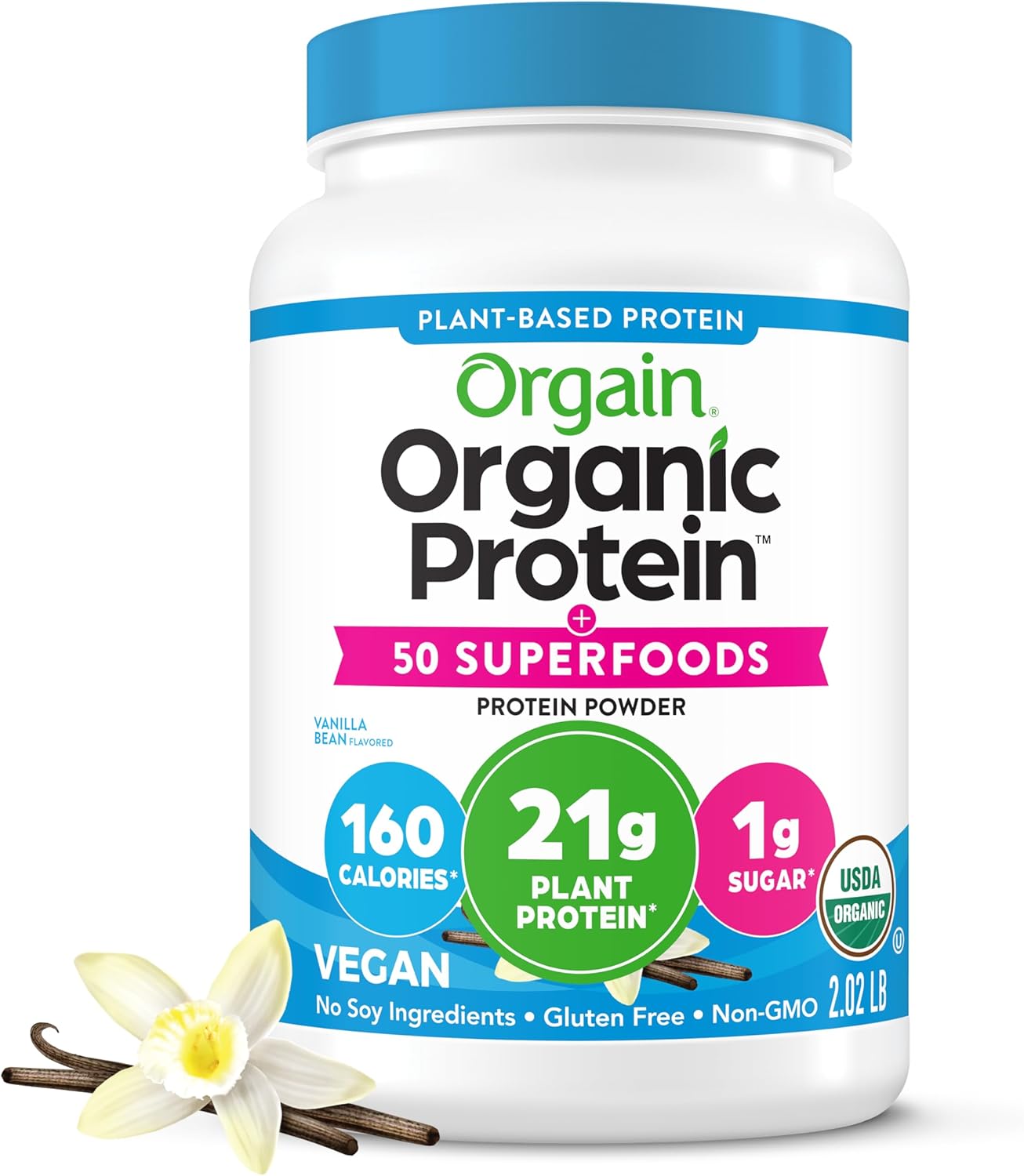
4. Orgain Organic Protein + Superfoods (Vanilla Bean) — Best Dairy-Free Option
Specs at a Glance
Type: Organic plant-based (pea + brown rice + chia)
Protein per serving: 21g
Superfoods: 50 organic superfoods per scoop
Fiber: 5g prebiotic fiber per serving
Calories: 160 per serving
Sugar: 1g | Carbs: 15g
Certifications: USDA Organic, Non-GMO, Vegan, Gluten-Free, Soy-Free
Price/serving: ~$1.75–$2.00
Click image to check price on Amazon
If you’re avoiding dairy — whether from lactose intolerance, dairy sensitivity, or personal choice — Orgain’s Organic Protein + Superfoods is the cleanest plant-based option in this roundup. USDA Organic, non-GMO, soy-free, gluten-free, and vegan, with no artificial sweeteners or preservatives. The ingredient list is genuinely clean.
The protein blend (organic pea protein, brown rice protein, chia seeds) is well-designed for a plant-based formula. Pea protein provides the bulk of the amino acids including a reasonable leucine content, while brown rice contributes methionine — the amino acid pea protein is relatively lower in. Together they create a more complete amino acid profile than either source alone. It’s not identical to whey, but it’s a solid foundation.
The 50-superfoods blend per scoop is the differentiator that makes Orgain more than just a protein powder. Kale, spinach, broccoli, quinoa, beets, acai, turmeric — 50 organic ingredients in a single serving. To be clear: the amounts of each individual superfood are small (this isn’t replacing your vegetable intake), but as a complement to an otherwise balanced diet it adds meaningful nutritional density. The 5g of prebiotic fiber also supports gut health — increasingly important after 40 as the gut microbiome changes.
Taste-wise, the vanilla bean is described by users as smooth and mildly sweet without being overwhelming. The texture is slightly thicker than whey when mixed with just water — almond milk or oat milk produces a notably better result. Some users note it doesn’t mix as cleanly as whey without a blender. For smoothies, it’s excellent. For a quick shaker cup, expect a slightly thicker consistency.
What we like
- USDA Organic, non-GMO, soy-free, gluten-free, dairy-free — the cleanest label in this roundup
- 50 organic superfoods per serving — meaningful nutritional density beyond just protein
- 5g prebiotic fiber — supports gut health alongside protein goals
- Pea + rice + chia protein combination creates a near-complete amino acid profile
- No artificial sweeteners — uses organic stevia and erythritol
- Best choice for lactose intolerant women or those who prefer plant-based products
What to know before buying
- 21g protein is solid but lower than the whey options — may need larger serving to match muscle-building doses
- Thicker texture than whey — works best in a blender with almond/oat milk, less ideal in a shaker with water only
- Higher carb count (15g) from the superfoods blend — relevant for women closely tracking carbohydrates
- Some users report chalky aftertaste when mixed with water alone — add liquid of choice
5. Ancient Nutrition Multi Collagen with Probiotics — Best for Gut + Joint Support
Specs at a Glance
Type: Multi-collagen (10 types from 4 sources)
Collagen sources: Bovine, chicken, marine, eggshell membrane
Protein per serving (2 scoops): 18g
Probiotics: 4 billion CFU (Bacillus coagulans)
Vitamin C: 200% DV per 2-scoop serving
Servings: 40 per container
Certifications: Non-GMO, Grass-fed, GMP Certified, Made in USA
Price/serving: ~$0.85–$1.00

Click image to check price on Amazon
Where Vital Proteins keeps it simple with a single collagen source, Ancient Nutrition goes broader — 10 types of collagen from four real food sources (bovine, chicken, marine, and fermented eggshell membrane), plus vitamin C and shelf-stable probiotics in a single product. For women over 40 managing multiple concerns simultaneously — joints, gut health, skin, bone density — this covers more ground per scoop than any other product in this review.
The type II collagen from chicken bone broth concentrate is particularly relevant for joint health. A 2016 study found that 40mg of undenatured type II collagen daily reduced joint pain in people with knee osteoarthritis. While Ancient Nutrition doesn’t disclose exact amounts of each collagen type (it’s a proprietary blend), the inclusion of type II alongside types I, III, V, and X provides a broader spectrum of collagen support than bovine-only products.
The probiotics addition is genuinely smart formulation. Bacillus coagulans — the specific strain used — is shelf-stable (no refrigeration needed), survives stomach acid, and has therapeutic research behind it for gut health. Since collagen supports gut lining integrity, pairing the two in one product has logical coherence. The vitamin C (200% DV per 2-scoop serving) is there because your body needs vitamin C to synthesize collagen — without it, supplementing collagen is less effective.
Honest callouts: it’s a proprietary blend, so you can’t verify exactly how much of each collagen type you’re getting. The unflavored version has a subtle savory taste that some describe as mild chicken broth — it mixes well in coffee and hot liquids but may be noticeable in plain water. It also contains fish and egg allergens from the marine and eggshell sources — not suitable for anyone with those allergies.
At ~$0.85–$1.00 per serving for 40 servings, it’s actually the best value in this roundup — a meaningful price advantage over Vital Proteins at the same or higher functional breadth.
What we like
- 10 types of collagen from 4 sources — the most comprehensive collagen profile in this review
- 4 billion CFU shelf-stable probiotics — no refrigeration, survives stomach acid
- 200% DV vitamin C per 2-scoop serving — directly supports collagen synthesis
- Best price per serving in this roundup (~$0.85–$1.00)
- GMP Certified, made in USA — quality manufacturing standards
- 40 servings per container — over 6 weeks supply at one-scoop daily
What to know before buying
- Proprietary blend — exact amounts of each collagen type not disclosed
- Contains fish and egg allergens — not suitable for those with these allergies
- Subtle savory taste in plain water — best in coffee, tea, or smoothies
- Not a complete protein — doesn’t replace whey or plant protein for muscle building
- Not NSF Certified for Sport — though GMP certified for quality manufacturing
How to Choose the Right Protein Powder After 40
Four questions to work through:
1. What is your primary goal?
Building muscle and improving body composition → Whey protein (#2 or #3). Joint pain, skin health, and bone density support → Collagen (#1 or #5). Both simultaneously → one of each, used at different times. Avoiding dairy completely → Orgain plant protein (#4).
2. Do you have any dietary restrictions?
Lactose intolerant or dairy-free → Orgain (#4) or either collagen option. Fish or egg allergy → avoid Ancient Nutrition (#5), choose Vital Proteins (#1) or whey options. Vegan → Orgain (#4) only. Gluten-free → all five products qualify.
3. Do you prioritize clean ingredients?
Artificial sweeteners are a dealbreaker → Orgain (#4) or the collagen options. Comfortable with artificial sweeteners for best value → Premier Protein (#3) or ON Gold Standard (#2).
4. What’s your budget per serving?
Under $1.00/serving → Ancient Nutrition (#5) at ~$0.85. $1.00–$1.50/serving → ON Gold Standard (#2). $1.50–$2.00/serving → Premier Protein (#3) or Vital Proteins (#1). Around $2.00/serving → Orgain (#4).
Research increasingly suggests that distributing protein across meals — rather than loading most of it at dinner — produces better muscle protein synthesis outcomes. Aim for at least 20–30g per meal across 3–4 meals. Using protein powder as one of those meals or post-workout fills that distribution requirement efficiently. The timing relative to your training session matters too: consuming protein within 2 hours post-workout is when muscle protein synthesis peaks.
Frequently Asked Questions
Current research for active women over 40 suggests 1.6–2.0g of protein per kilogram of bodyweight daily — significantly more than the general health guideline of 0.8g/kg. For a 140-pound (63.5 kg) woman, that’s 100–127g of protein per day. Protein powder helps fill the gap when whole food alone isn’t sufficient or convenient.
No — they are fundamentally different products. Whey protein is a complete protein (contains all 9 essential amino acids) with high leucine content, making it effective for muscle building and recovery. Collagen protein is not complete — it’s missing tryptophan — and is not effective as a primary muscle-building protein source. Collagen’s benefits are joint health, skin elasticity, hair, nails, and bone density support. Many women over 40 use both: whey post-workout for muscle, collagen in morning coffee for structural support.
Yes. Whey protein is well-researched and considered safe for healthy adults. Women with lactose intolerance may experience mild digestive discomfort from whey concentrate — whey isolate (which has more lactose removed) or plant protein are better alternatives in that case. Always consult your doctor if you have kidney disease, as high-protein diets require medical guidance in that context.
Post-workout — within 2 hours of training — is when muscle protein synthesis is most active. That’s the highest-leverage time for a protein shake. Beyond timing, what matters most is hitting your total daily protein target across meals. Collagen specifically can be taken any time of day but mixes particularly well in morning coffee or tea.
Indirectly, yes. Higher protein intake supports satiety (feeling full), preserves muscle mass during a caloric deficit, and increases the thermic effect of food (protein requires more calories to digest than carbs or fat). Protein powder isn’t a weight loss product, but it’s a useful tool for maintaining protein targets while managing calories — particularly as a meal component rather than an addition to an already adequate diet.
Either collagen option in this review: Vital Proteins (#1) for a simple, clean collagen with strong bioavailability, or Ancient Nutrition Multi Collagen (#5) for broader collagen types plus probiotics and vitamin C in one product. The type II collagen in Ancient Nutrition specifically targets joint cartilage — relevant for knee and hip discomfort. Use collagen alongside your regular protein source, not instead of it.
Gear + Nutrition + Training Plan
You’ve got the protein sorted. Now pair it with the right equipment and a beginner-friendly program designed specifically for women over 40.
Affiliate disclosure: The product links and images in this article are Amazon affiliate links. If you purchase through them, HerStrengthLab earns a small commission at no extra cost to you. Our editorial recommendations are based on product research, ingredient analysis, and customer review data — not on affiliate commission rates. See our full affiliate disclosure policy.
Medical disclaimer: This article is for informational purposes only and does not constitute medical or nutritional advice. Protein and supplement needs vary by individual health status, medications, and goals. Consult your doctor or a registered dietitian before making significant changes to your supplement regimen, especially if you have kidney disease, are pregnant, or are managing a chronic condition.