


Best Resistance Bands for Women Over 40 Resistance bands are the most underrated piece of home gym equipment for women over 40 — joint-friendly, genuinely versatile, and cheap enough that there’s no reason not to own a set. We reviewed five of the top options on Amazon, then wrote the buying guide you actually need to choose the right type.
| # | Band Set | Type | Resistance Range | Best For | Rating |
|---|---|---|---|---|---|
| 1 | VEICK 17-Piece Set | Tube + Loop | 10–150 lbs stackable | Best Overall | ★★★★½ |
| 2 | Handle Set 10–100 lbs | Tube with handles | 10–100 lbs | Best for Beginners | ★★★★ |
| 3 | 12-Piece Full Kit | Tube with accessories | 10–50 lbs | Best Budget / PT Use | ★★★★ |
| 4 | RENRANRING 150 lbs Set | Tube with handles | 10–150 lbs stackable | Best Heavy Resistance | ★★★★½ |
| 5 | Strength Training Loop Set | Long loop bands | Light to Heavy | Best for Full-Body Strength | ★★★★ |
Why Resistance Bands Are Especially Good After 40
Most resistance band buying guides treat bands as a beginner alternative to “real” weights — something you graduate away from once you get serious. That’s the wrong way to think about them, especially if you’re a woman over 40.
Here’s what bands actually offer that dumbbells don’t:
- Variable resistance through the full range of motion. A dumbbell is heaviest at the bottom of a curl and easier at the top. A band is the opposite — it builds resistance as it stretches, which means the hardest point is at full contraction. That’s where muscle activation is highest.
- Joint-friendly loading. Bands don’t load your joints with compressive force the same way free weights do. For women managing knee sensitivity, shoulder changes, or hip discomfort — all more common after 40 — bands let you train muscle groups that would otherwise be painful to load with iron.
- Constant tension. Unlike weights, bands don’t have a rest point. Your muscles stay engaged through the entire movement, including the eccentric phase. This matters for muscle building.
- Portability. A full set of resistance bands weighs under a pound and fits in a bag. Your dumbbells don’t travel to a hotel room. Your bands do.
None of this means bands replace dumbbells. The strongest home gym setup uses both — and our beginner’s guide covers exactly how to combine them. But if you can only choose one piece of equipment to start, bands make a genuinely strong case.
Every band in this review lists a resistance in pounds (10 lbs, 30 lbs, etc.). Those numbers are estimates — resistance bands don’t apply force in pounds the way a dumbbell does. The rated resistance is typically the peak tension at full stretch, not a fixed load. Use the ratings to compare bands within the same set, not as absolute weights. A “30 lb” band from one brand will feel different than a “30 lb” band from another.
The 3 Types of Resistance Bands — And Which One You Actually Need
Before buying anything, you need to know which type of band you’re looking at — because they do different things and are not interchangeable.
1. Tube bands with handles
These are the most common type in this review — hollow rubber or latex tubes with soft grip handles on each end. They’re beginner-friendly because the handles make every exercise intuitive, they work well with door anchors for cable-style movements, and they’re the easiest to use for upper body work (rows, presses, curls, lateral raises).
Best for: Upper body exercises, beginners, physical therapy, cable machine alternatives.
2. Long loop bands (flat bands)
Large continuous loops, typically 40–48 inches long. No handles — you step on them, wrap them around a pull-up bar, or use them for assisted bodyweight movements. These are what you see in CrossFit gyms for pull-up assistance. They also work for squats, deadlifts, and hip thrusts when loaded with your body weight. More versatile than tube bands but require more setup knowledge.
Best for: Lower body strength work, assisted pull-ups, full-body compound movements, experienced band users.
3. Mini loop bands (booty bands)
Small loops, typically 12 inches, designed specifically for lower body activation — glute bridges, clamshells, lateral walks, banded squats. These aren’t in this review but worth knowing about as a complement to the sets below.
Best for: Glute activation, hip abduction, mobility work.
If you’re starting from zero: a tube band set with handles (#1, #2, or #4 below) for upper body work, combined with a separate mini loop band set for lower body work. That combination covers about 90% of what you need for the exercises in our beginner’s guide — for under $40 total.
5 Best Resistance Bands for Women Over 40
1. VEICK 17-Piece Resistance Band Set — Best Overall
Specs at a Glance
Type: Tube bands + loop bands combo
Bands included: 5 tube bands + 5 loop bands (12 total pieces)
Resistance levels: Yellow (10) · Blue (20) · Green (30) · Black (40) · Red (50 lbs)
Stackable max: 150 lbs combined
Band length: 48 inches
Material: Natural latex
Accessories: Handles, ankle straps, door anchor, carry bag
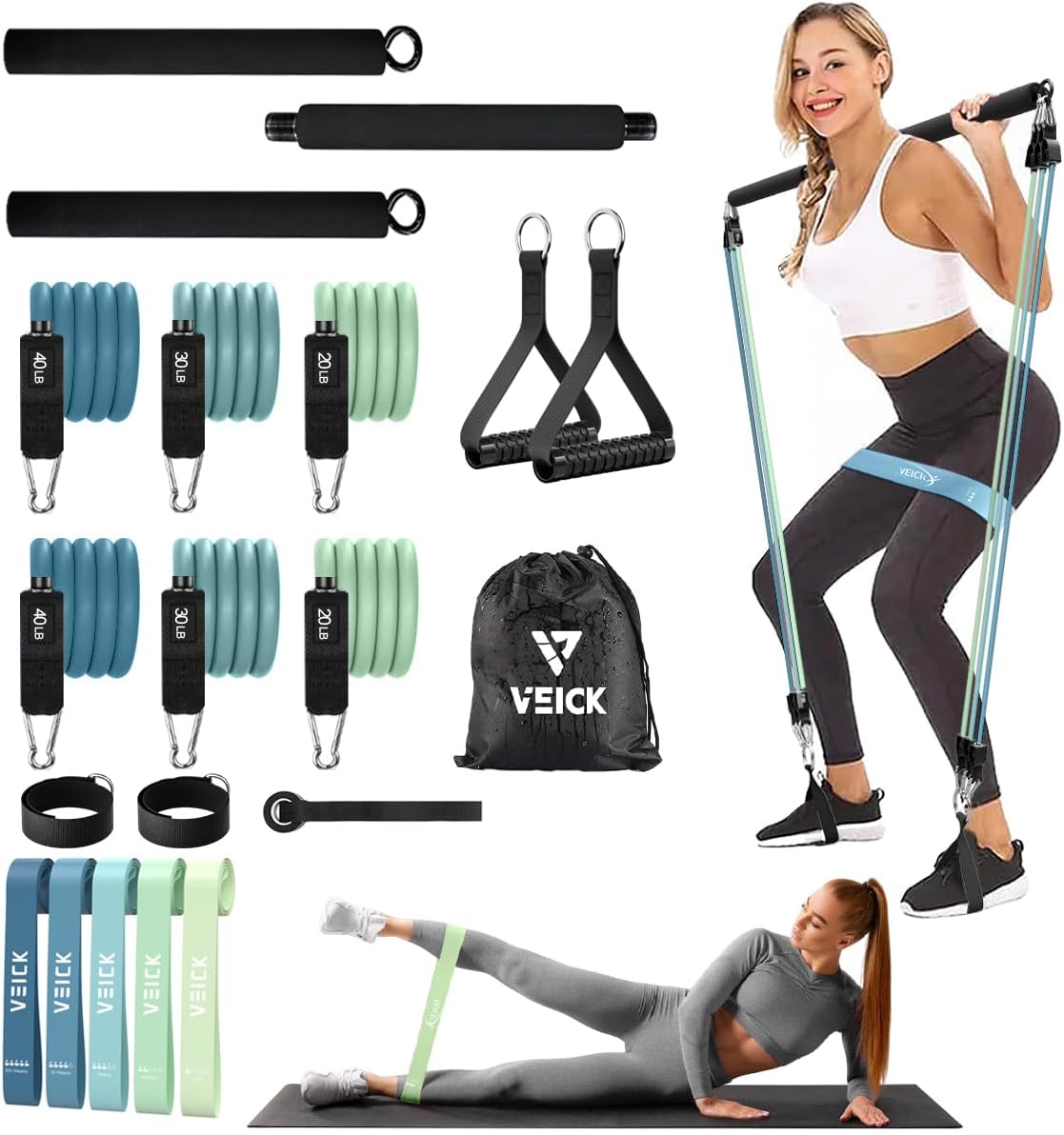 The VEICK set earns the top spot because it’s actually two sets in one. Five tube bands for upper body and handle-based work, five loop bands for lower body, pull-up assistance, and compound movements — all in the same carry bag. For women who want one purchase that covers everything, this is it.
The natural latex construction is the right material choice. Latex has better snap-back than synthetic alternatives and holds up longer under repetitive tension. The 48-inch band length gives you enough range to work through full movement patterns without the band bottoming out before you reach peak contraction — a problem with shorter sets.
The resistance levels are well-spaced. Starting at 10 lbs and moving up in 10 lb increments to 50 lbs, each band represents a meaningful step up in difficulty — not the tiny jumps you get in cheaply-made sets where the “light” and “medium” bands feel nearly identical. Stack two bands for heavier resistance up to 150 lbs if you need it, though most women over 40 will find the individual bands sufficient for at least a year of training.
The door anchor is robust. This matters more than it sounds — a flimsy door anchor is a safety issue, not just an inconvenience. The VEICK anchor sits securely even under heavy pulling loads, which means you can do rowing movements and cable-style exercises with confidence.
What we like
- Two band types in one set — covers upper and lower body work completely
- Natural latex holds tension and snaps back cleanly — no dead feeling mid-rep
- 48-inch length accommodates tall women and full range movements
- Well-spaced resistance levels — each band is a genuine step up
- Door anchor is solid enough for heavy rowing movements
- Ankle straps included — enables lower body isolation exercises
What to know before buying
- 17 pieces is a lot to manage — set up a storage system before your first session
- Natural latex means possible sensitivity for anyone with latex allergies — check first
- The loop bands require more exercise knowledge than tube bands — watch a tutorial before use
2. Resistance Bands with Handles (10–100 lbs) — Best for Beginners
Specs at a Glance
Type: Tube bands with handles
Resistance levels: 5 levels from 10 to 100 lbs
Target users: Women, beginners, physical therapy
Accessories: Door anchor, storage pouch
Use cases: Yoga, Pilates, physical therapy, strength training
Best use: Upper body, seated exercises, PT movements
 This set is designed specifically for women — and it shows in how it’s spec’d. The resistance range starts genuinely light (10 lbs) for women who are rebuilding after injury, in physical therapy, or starting from zero. The inclusion of yoga and Pilates in the product description isn’t just marketing: the lighter bands in this set are appropriate for the kind of controlled, slow-tempo movements those disciplines use.
The 5-level progression is clean and beginner-appropriate. The handles are cushioned and comfortable — a detail that matters more than it sounds when you’re holding a handle through 3 sets of 12 curls with sweaty palms. The storage pouch keeps everything tidy, which matters for motivation: equipment you can find easily is equipment you actually use.
One honest note — the “100 lbs” headline is the maximum combined resistance if you stack all five bands together, which is not a realistic use case for most women. Treat the individual band ratings as your working guides. The heavier end of the individual bands in this set is where intermediate users will find themselves within 6 months of consistent training.
The door anchor is functional for basic pulls and rows. It’s not as heavy-duty as the VEICK anchor, so if you plan to do a lot of heavy resistance rowing, the VEICK or RENRANRING sets would be a better match for long-term use.
What we like
- Genuinely beginner-appropriate starting resistance — not falsely light or misleadingly heavy
- Designed with women specifically in mind — lighter starting bands, appropriate progression
- Comfortable cushioned handles reduce hand fatigue during longer sessions
- Good for physical therapy, yoga, and Pilates as well as strength training
- Clean storage pouch — keeps the set organized and ready to use
What to know before buying
- The “100 lbs” max is combined — individual bands are much lighter; read specs carefully
- Door anchor is adequate but lighter-duty than competing sets — not ideal for very heavy resistance
- Some customer reviews note that resistance ratings can feel slightly inconsistent — use bands as a progression tool, not as calibrated weights
3. 12-Piece Full Kit — Best Budget Pick & Best for Physical Therapy
Specs at a Glance
Type: Tube bands — full accessory kit
Kit includes: Bands, handles, door anchor, ankle straps, carry bag
Total pieces: 12
Target areas: Arms, shoulders, chest, legs
Customer praised for: Shoulder rehab, PT exercises
Price point: Most affordable in this roundup
 The 12-piece kit earns a mention here because of a specific customer pattern that keeps showing up in its reviews: women using it for shoulder rehabilitation exercises. Shoulder health is a real concern for women over 40 — the rotator cuff becomes more vulnerable with age, and the kinds of gentle, controlled resistance movements that physical therapists prescribe are exactly what this set handles well.
At the most affordable price point in this roundup, it’s also the lowest-risk entry if you’re unsure whether resistance bands will work for your needs. If you’re being guided by a physical therapist and want a home set to continue your prescribed exercises, this is the one to show your PT and ask if it’s appropriate. In most cases, it will be.
The complete accessory kit — handles, ankle straps, door anchor, carry bag all included — means you don’t need to buy anything separately. For shoulder exercises specifically: the door anchor placement at different heights (top, middle, bottom of the door) creates the cable positions that PT protocols use most often.
Where it earns honest criticism: the band quality is more basic than the VEICK or RENRANRING sets. For light-to-moderate resistance work and PT exercises, it’s absolutely fine. For progressive strength training over months, you’ll notice the limitations. Think of it as a starter set — genuinely useful, but something you might upgrade from in 12 months if training becomes a consistent habit.
What we like
- Best price point in this roundup — lowest risk starting investment
- Specifically praised by customers for shoulder rehab and physical therapy use
- Complete kit — every accessory you need is included out of the box
- Door anchor at multiple heights makes it versatile for PT-style cable movements
- Lightweight and portable — easy to carry to PT appointments or a hotel room
What to know before buying
- Build quality is more basic than premium sets — appropriate for light/moderate use, not heavy progressive training
- Heavier resistance levels in the set may feel less smooth than higher-quality latex alternatives
- Best positioned as a starter or PT-use set — serious strength trainers should look at VEICK or RENRANRING
4. RENRANRING 150 lbs Resistance Band Set — Best Heavy Resistance
Specs at a Glance
Type: Tube bands with handles
Resistance levels: 5 levels — 10 / 20 / 30 / 40 / 50 lbs
Stackable max: 150 lbs
Band length: 51 inches
Material: High-quality rubber — non-latex
Accessories: Handles, ankle straps, waterproof carry bag
Amazon rating: 4.5 stars · 4,000+ reviews
 Four thousand-plus reviews on Amazon is real-world durability testing at scale. The RENRANRING set has earned its rating through actual use, not launch-day hype. The non-latex rubber construction is the standout detail — if you have any latex sensitivity (more common than most people realize), this is your option without compromise on resistance quality.
The 51-inch band length is the longest in this roundup. That extra three inches matters more than it sounds for taller women and for exercises that require a wide stance or extended arm position. The resistance doesn’t bottom out on exercises where shorter bands would reach their limit too early.
The handle design is worth calling out specifically. The anti-slip texture on the RENRANRING handles is more effective than the standard foam grip on cheaper sets — especially for the kinds of compound pulling movements (rows, lat pulldowns, face pulls) where hand fatigue tends to limit your sets. The handles are also wide enough that you can use them with an overhand or underhand grip without repositioning.
The waterproof carry bag is a practical upgrade over the standard cloth pouches on competing sets. If you’re using bands at home and the bag lives in a gym bag that might get wet, or you want to take the bands to outdoor workouts, waterproofing extends the life of everything inside.
At the heavier end — the 40 and 50 lb individual bands — the RENRANRING set provides meaningful resistance for experienced users. Most women starting out won’t touch the heaviest bands for months, but knowing they’re there when you need them is the whole point of buying a quality set.
What we like
- Non-latex construction — safe for women with latex sensitivity
- 51-inch length — the longest in this roundup, great for taller women and wide-stance movements
- 4,000+ verified Amazon reviews — real durability track record
- Wide anti-slip handles with multiple grip options
- Waterproof carry bag — a practical upgrade over standard cloth pouches
- Heavy end resistance (40–50 lbs per band) covers intermediate to advanced users
What to know before buying
- Non-latex rubber doesn’t have quite the same snap-back quality as natural latex — slight difference in feel, not in function
- 5-level resistance with 10 lb increments means fewer mid-range steps than some users want
- At the heaviest configurations, check carabiner connections before each use
5. Strength Training Loop Set — Best for Full-Body Strength Work
Specs at a Glance
Type: Long loop bands
Resistance levels: Light / Medium / Heavy / X-Heavy
Use cases: Squats, deadlifts, rows, pull-up assistance, stretching
Material: Natural latex
Best for: Full-body compound movements
No handles: More versatile placement options
 Long loop bands are the most versatile type on this list — and also the one that requires the most from the user. There are no handles to guide your grip, no door anchor system to set up a cable position. You step on them, wrap them, or anchor them however your exercise requires. That flexibility is the whole point.
For the exercises that matter most to women building strength after 40 — Romanian deadlifts, squats, hip thrusts, bent-over rows — long loop bands let you load these patterns in ways tube bands can’t. Step on the band, hold the top of the loop at shoulder height, and you have a banded squat that trains the same pattern as a barbell squat but with lighter, joint-friendlier loading. Add the band above your knees during a hip thrust and you’re activating the glute medius in a way most women never target.
The progressive resistance profile of loop bands is particularly valuable for the hip hinge. As you stand up from a Romanian deadlift with a loop band, the tension increases — which means the hardest part of the movement is at lockout, exactly where the glutes are at peak contraction. That’s not how a dumbbell works, and it’s not something a tube band can replicate easily.
Honest note: this set has a steeper learning curve than tube bands. If you’ve never used loop bands before, spend 20 minutes watching exercise demonstrations before your first session. The exercises aren’t difficult, but the band placement options aren’t as obvious as a handle telling you exactly where to grip.
What we like
- Most versatile type for compound strength movements — squats, hinges, rows, carries
- Progressive resistance profile is ideal for glute and hamstring work
- Can be used for pull-up assistance — valuable as you get stronger
- Natural latex provides clean snap-back and consistent tension
- Multiple resistance levels cover beginner through intermediate strength
What to know before buying
- No handles — requires more exercise knowledge than tube band alternatives
- Not ideal as a standalone first purchase — works best paired with a tube band set for upper body
- Watch exercise demos before your first session — band placement isn’t always intuitive
- Natural latex means potential sensitivity for anyone with latex allergies
Complete Buying Guide: How to Choose the Right Resistance Bands
Five questions to work through before you buy:
1. What exercises are you planning to do?
Upper body focus (rows, curls, presses, lateral raises) → tube bands with handles. Lower body focus (squats, hip thrusts, RDLs) → long loop bands. Both → buy one set of each, or the VEICK combo set (#1) that includes both types.
2. Do you have a latex sensitivity?
If yes, the RENRANRING (#4) is your only option in this roundup — it’s the sole non-latex set. All others use natural latex rubber.
3. Are you recovering from an injury or doing PT exercises?
The 12-Piece Budget Kit (#3) is specifically suited here — repeatedly praised in reviews for shoulder rehab specifically, complete accessory kit, and light starting resistance appropriate for therapeutic use. Show it to your physical therapist before buying.
4. How long do you want to use this set before upgrading?
Starting out and not sure if bands are for you → Budget Kit (#3) — lowest financial risk. Planning to train consistently for 18+ months → VEICK (#1) or RENRANRING (#4) — quality and resistance range that grows with you.
5. What’s your budget?
Under $20 → Budget Kit (#3). $20–35 → Handle Set (#2) or RENRANRING (#4). $35–50 → VEICK (#1) for the complete combo set. All five options in this roundup are under $50 — resistance bands are genuinely affordable.
Look at the carabiner clips — the metal hooks that connect bands to handles. Cheap carabiners are the most common failure point in budget band sets. They don’t break bands — they snap open under load and the band snaps back. Read recent customer reviews specifically for comments about carabiner quality before purchasing any set not in this review. All five sets reviewed here have adequate carabiners for their resistance ranges.
5 Best Resistance Band Exercises for Women Over 40
These five movements cover the same foundational patterns as the dumbbell exercises in our beginner’s guide — but with the joint-friendly loading profile that makes bands especially useful after 40.
| Exercise | Pattern | Muscles Worked | Band Type | Sets × Reps |
|---|---|---|---|---|
| Banded Romanian Deadlift | Hip hinge | Hamstrings, glutes, lower back | Loop band | 3 × 12 |
| Seated Band Row | Pull | Mid back, rear delts, biceps | Tube band + door anchor | 3 × 12 |
| Banded Hip Thrust | Hip extension | Glutes, hamstrings, core | Loop band above knees | 3 × 15 |
| Band Pull-Apart | Shoulder / posture | Rear delts, rhomboids, rotator cuff | Tube or loop band | 3 × 15 |
| Banded Lateral Walk | Hip abduction | Glute medius, hip stabilizers | Mini loop or long loop | 3 × 10 steps each way |
One exercise worth highlighting: the Band Pull-Apart
This is the single most underused exercise for women over 40 — and it directly addresses one of the most common structural changes that happens with age: rounded shoulders and forward head posture. Hold a band at chest height with both hands shoulder-width apart, then pull the band apart until your arms are fully extended to your sides. The tension targets the rear deltoids and rhomboids, the muscles responsible for pulling your shoulders back and down into correct position. Do 15 reps before every training session as a warmup. It takes 90 seconds and pays off over months of consistent posture improvement.
Frequently Asked Questions
Yes — and the research supports it. Resistance bands provide progressive mechanical tension, which is the primary stimulus for muscle growth. The variable resistance profile (increasing tension through the range of motion) may actually produce better muscle activation in certain exercises than fixed-weight dumbbells. Used consistently with progressive overload — gradually using heavier bands or combining bands — they build real strength and muscle mass.
Start with the lightest band in whatever set you buy — typically 10–15 lbs rated resistance. This sounds lighter than you think you need, but controlled resistance band movements at lighter loads are more challenging than they appear. Master the movement quality first. Add resistance when you can complete all reps with clean form and the last two reps still feel genuinely manageable.
Resistance bands are often recommended specifically for people managing joint pain because they load joints differently than free weights — with less compressive force and more controlled tension. That said, any exercise program should be cleared with your doctor or physical therapist if you’re managing a diagnosed condition. Bands are a common tool in physical therapy precisely because they’re joint-friendly, but “joint-friendly” doesn’t mean “appropriate for every condition without guidance.”
A quality natural latex or rubber band set, stored correctly (away from direct sunlight and heat, not kinked or tangled), typically lasts 1–3 years of regular use. The failure points to watch are the carabiner clips (metal fatigue under heavy use) and the band ends where they meet the clips (where cracking begins). Inspect your bands before each session. If you see cracking, white stress marks, or the band feels brittle — replace it. A snapped band under load is a real injury risk.
For beginners, bands can cover most of what you need for the first several months. Long term, they work best as a complement to dumbbells — not a replacement. Dumbbells offer fixed, calibrated resistance that makes progressive overload easy to track. Bands offer variable resistance and joint-friendly loading for specific movements. The strongest home gym setup uses both. If you can only buy one, bands are a cheaper, lower-risk starting point — but plan to add dumbbells as you progress.
The RENRANRING set (#4) is the only non-latex option in this roundup. It uses high-quality synthetic rubber that provides comparable resistance and durability without latex. If latex sensitivity is a concern, this is your set — don’t compromise on this detail.
Add Dumbbells to Your Setup
Resistance bands handle the joint-friendly work. Adjustable dumbbells cover progressive strength training. Together, they’re everything you need for 18+ months of home training — without spending more than $150 total.
Affiliate disclosure: Links in this article are Amazon affiliate links. We earn a small commission on qualifying purchases at no extra cost to you. Our editorial recommendations are based on product research and customer review analysis — not on commission rates. See our full affiliate disclosure policy.
Health note: If you are managing a joint condition, injury, or chronic pain, consult your doctor or physical therapist before beginning a resistance band training program. This article is for informational purposes and does not constitute medical advice.